What This Episode Covers
Episode 21 revealed how the asbestos industry moved suppression from personal letters to institutional votes — committees with bylaws, trade associations with meeting minutes, a bureaucracy that could decide to bury science without any single executive taking personal responsibility. Episode 22 reveals the next layer: how the industry didn't just vote to suppress research, it purchased the right to suppress it before the research even happened.
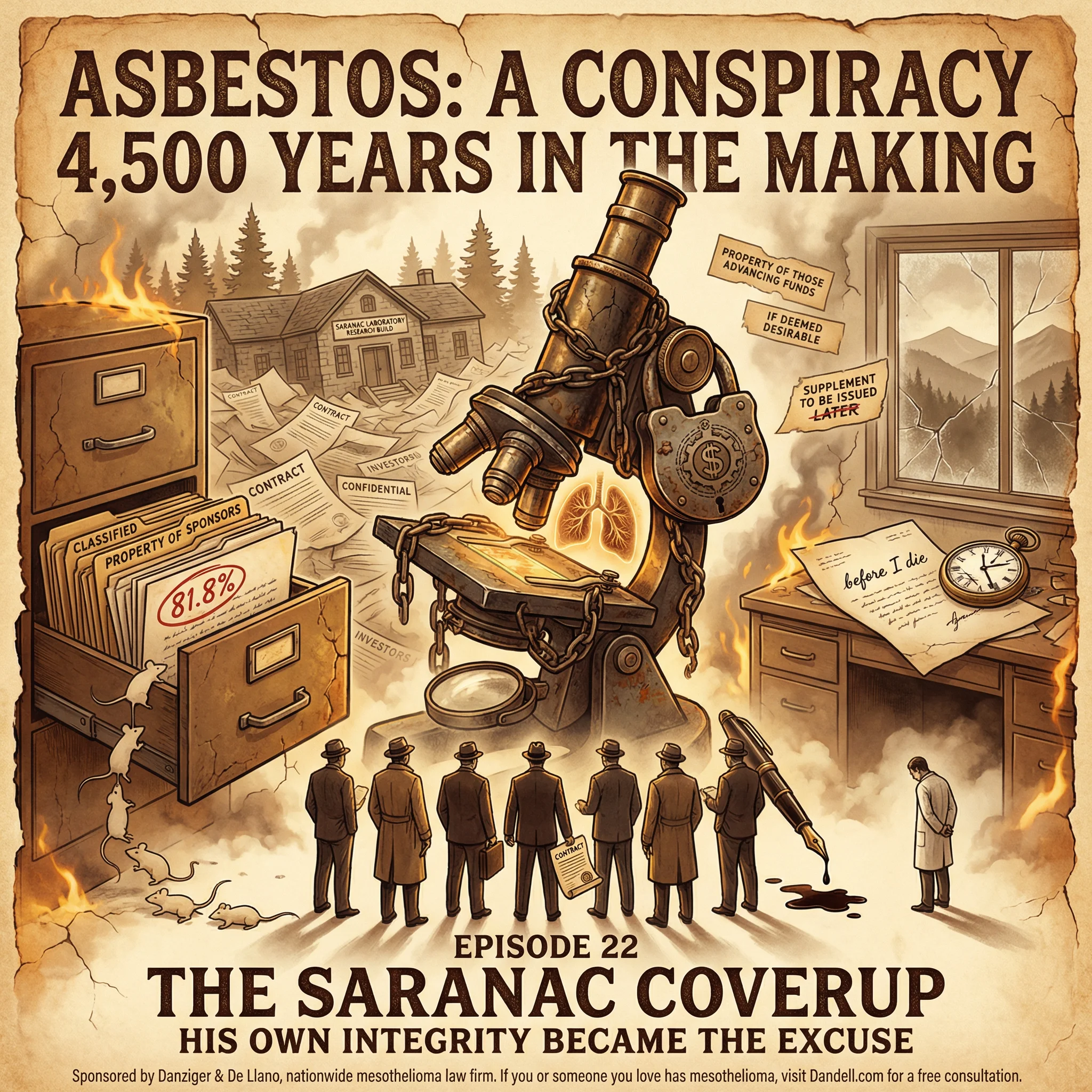
The Saranac Laboratory sat in the Adirondack Mountains, founded to treat tuberculosis, transformed by one man's unlikely survival into a serious research institution. In 1936, that institution needed money. Nine asbestos companies made an offer — approximately $5,000 per year to fund dust research. Buried in the funding contract was a clause that would define the next 52 years: all results would be "property of those advancing the required funds," and publication would occur only "if deemed desirable" by the sponsors.
Dr. LeRoy Upson Gardner — the Yale pathologist who'd arrived at Saranac in 1917 as a dying tuberculosis patient and stayed to run the laboratory — signed it. And then, seven years later, he found something the industry had paid to own and never intended to publish.
Key Takeaways
- Nine companies bought the right to silence science before it happened — The 1936 contract made Gardner's findings the sponsors' "property" and gave them veto power over publication.
- Gardner discovered an 81.8% tumor rate in 1943 — Asbestos-exposed mice developed malignant tumors at 16 times the rate of control groups. Seventeen years before the "official" discovery.
- Gardner's own integrity became the industry's cover — He recommended omitting cancer data pending controlled experiments. After his death, the industry used his caution as permanent justification.
- The NCI rejected his only escape route — Gardner's $10,000 grant application for independent controlled experiments was unanimously rejected in January 1944, trapping him with industry funding.
- He wrote "before I die" — and six months later he was dead — His April 1946 letter to Johns-Manville requesting access to worker X-rays contains the most haunting five words in the episode.
- The 1947 suppression vote defined cancer as "objectionable material" — Nine companies voted to delete all cancer references. Vandiver Brown ordered sponsors to return draft copies so no evidence of the cuts would survive.
- 52 years of silence — The full data wasn't published until 1995, when Dr. Gerrit Schepers finally put Gardner's 81.8% figure in the scientific record.
The Contract That Bought Silence
November 20, 1936. Nine companies signed on to fund Saranac Laboratory: Johns-Manville, Raybestos-Manhattan, Keasbey & Mattison, U.S. Gypsum, American Brakeblok, Asbestos Manufacturing Co., Gatke Corp., Russell Manufacturing, and UNARCO. Vandiver Brown — the same Johns-Manville general counsel who received Sumner Simpson's "the less said about asbestos, the better" letter the year before — organized the contract.
The contract language was precise. Results would be "property of those advancing the required funds." Publication would occur only "if deemed desirable." These weren't ambiguous clauses — they were deliberate legal architecture, drafted by attorneys who understood exactly what they were buying. Not a research study. The right to decide whether a research study would ever be seen.
Gardner needed the money. The Great Depression had devastated charitable giving. The Saranac Laboratory had survived on donations that no longer came. Asbestos dust research was a natural extension of the silicosis work Gardner was already doing. He signed. And the industry, for approximately $5,000 per year split nine ways, purchased ownership of whatever science a Yale pathologist would spend the next seven years producing.
What nine asbestos companies paid to own all of Gardner's research — including the right to decide if it would ever be published
What Gardner Found
From 1936 to 1943, the Saranac Laboratory ran systematic dust experiments. Over 800 mice exposed to silica, quartz, flint, and asbestos. The asbestos group inhaled long chrysotile fibers for 15 to 24 months. Gardner wasn't looking for cancer — he was investigating asbestosis, the fibrotic lung disease the industry had been arguing about for decades. Cancer was an accident of discovery.
In February 1943, Gardner compiled his findings. Eleven mice had survived the full asbestos exposure protocol. Eight had developed malignant tumors in their lungs. Nine of the eleven had tumors somewhere in their bodies. Gardner wrote the finding in the clinical language of a scientist documenting something that alarmed him: "The incidence rate 81.8% is excessive." Excessive. Compared to an average tumor rate of about 19% in other dust groups — the asbestos mice were developing cancer at sixteen times the background rate.
And then the trap closed. Gardner's experiments had a methodological flaw: the mice weren't genetically controlled. He'd used a strain that was unusually susceptible to cancer. The finding was real — asbestos was causing cancer — but the experiment couldn't prove it conclusively without proper controlled conditions. He needed to run the experiment again with 500 mice bred for cancer resistance. He needed two to three years. He needed money he couldn't ask the sponsors for, because they'd know exactly what he was looking for.
Tumor rate in asbestos-exposed mice — 16x higher than controls — documented by Gardner in February 1943 and suppressed for 52 years
The Trap: Gardner's Own Integrity
This is the detail that makes the Saranac story more complicated than a simple corporate coverup. In February 1943, Gardner wrote a cover letter to Vandiver Brown — the Johns-Manville lawyer who held the contract. And in that letter, Gardner himself recommended leaving the cancer data out of the published report.
His exact words: "The question of cancer susceptibility now seems more significant than I had previously imagined. I believe I can obtain support for repeating it from the cancer research group. As it will take two or three years to complete such a study, I believe it would better be omitted from the present report."
Gardner was being honest. He knew the data was suggestive but not conclusive. He wanted to do the experiment properly before making a claim that would face industry attack. That's good science. And it handed the industry exactly the cover it needed. After Gardner's death, "omitted from the present report" became the industry's permission slip — a scientist's own words, used to justify permanent suppression of the most significant cancer finding the asbestos industry would ever fund.
The One Escape Route — Closed
Gardner had one way out: independent funding. In March 1943, he applied for a $10,000 grant from the National Cancer Institute to conduct the properly controlled experiments. If the NCI funded it, the work would be independent. The industry's ownership clause wouldn't apply. The results could be published without sponsor approval.
January 8, 1944. A committee chaired by Dr. Ludvig Hektoen — a figure so prominent in American medicine he was called "the grand old man" — reviewed Gardner's application. The methodological critique was technically correct: without genetic controls, the 81.8% figure was ambiguous. Some mouse strains develop cancer naturally at high rates. But Gardner wasn't asking the NCI to accept his flawed results. He was asking for $10,000 to conduct the controlled experiments that would settle the question definitively. The committee rejected it. Unanimously.
The escape hatch closed. Gardner remained trapped with industry funding. The one institutional mechanism that could have freed his science to serve the public rejected his application on the same grounds the industry would later use to dismiss his findings entirely.
"Before I Die"
April 8, 1946. Six months before his death. Gardner writes to J.P. Woodard at Johns-Manville. He wants to review chest X-rays from Johns-Manville workers — human evidence that might confirm or challenge what he'd seen in mice. And in that letter, he writes five words that carry the full weight of the episode: "I hope, before I die, the opportunity may be afforded us."
Was he sick? The historical record doesn't confirm it. What the record confirms is this: on October 24, 1946, LeRoy Upson Gardner died suddenly of a heart attack. He was 57 years old. The man who had survived tuberculosis in 1917, who had stayed at Saranac to run the laboratory that saved him, who had discovered evidence of asbestos-caused cancer 17 years before the scientific establishment would acknowledge it — died without seeing his work published. His notes, his slides, his handwritten observations, his 81.8% figure — all of it, property of the nine companies that had paid to own it.
From Gardner's 1943 discovery to Schepers' 1995 publication — the length of a suppression sustained by a contract, a vote, and five words in a cover letter
The Human Evidence
It wasn't only mice. By 1943, Gardner had documented 11 cases of human lung cancer in Quebec asbestos miners and millers — including 2 mesotheliomas. Seventeen years before the asbestos-mesothelioma connection would be "officially" established by Dr. Irving Selikoff. Workers' lungs had been shipped from Johns-Manville's Quebec facilities to Saranac Laboratory by Ivan Sabourin, general counsel for the Quebec Asbestos Mining Association — transported across the international border in the trunk of his car, on repeated trips, directly to the laboratory funded by the industry that employed those workers.
The results went to Sabourin. The company doctors treating the sick workers were not informed. The families were told their loved ones died from smoking. By 1958, the files at Saranac contained over 70 unreported lung cancer cases from Quebec miners. Not one of those families was ever told the truth.
The 1947 Suppression Vote
Gardner died in October 1946. Within months, Arthur Vorwald — his successor at Saranac — was preparing to publish the research. The nine sponsor companies had a problem: the publication they owned contained the cancer finding they'd paid to suppress.
In early 1947 — most sources say January — representatives of the nine funding companies met. Their decision, documented in court records from the Sumner Simpson Papers, was precise: publication "would not include any objectionable material." They defined "objectionable" in the minutes: "any relation between asbestos and cancer." Then Vandiver Brown sent instructions. Delete all references to "cancers and tumors." And return all draft copies — because, in Brown's own language, it would be "unwise to have any copies of the draft report outstanding if the final report was to be different in any substantial respect."
They wanted no evidence of what they'd cut. The only problem: they created evidence by writing down that they were cutting it.
The Sanitized Record and the 52-Year Gap
The 1948 Saranac report, published two years after Gardner's death, ran 42 pages. It discussed asbestosis thoroughly. It acknowledged, briefly, that tumors had been observed. And it promised: a supplement would be issued later with further discussion. The supplement was never published.
In 1951, Vorwald and colleagues published a journal article claiming to present "a complete survey of the entire experimental investigation." The 81.8% figure — Gardner's central finding — was deleted entirely. The sanitized science entered the public record. During those same years, five thousand Quebec asbestos miners went on strike in February 1949, demanding dust control and action on lung disease. They were fighting for what would have been their strongest weapon — proof that the industry already had. They lost the strike. Provincial police were dispatched. The companies that had suppressed the cancer evidence two years earlier prevailed.
In 1954, a South African researcher named Gerrit Schepers arrived at Saranac as Director of Research and found Gardner's files — the slides, the notes, the 81.8% figure, all of it. He raised what he'd found. He was told to stay quiet. He later described the experience in five words: "I complied thereafter in the United States." He became an expert witness in asbestos litigation for decades. But the full account didn't appear in a peer-reviewed journal until 1995 — the American Journal of Industrial Medicine, 52 years after Gardner wrote the finding that the industry paid to own and buried.
Why This Matters If You Were Exposed
The Saranac story is the blueprint — the mechanism by which the asbestos industry purchased scientific silence. The contract clause. The publication veto. The suppression vote. The deleted draft copies. The promised supplement that never appeared. These weren't ad hoc decisions made by bad actors. They were systematic tools, tested and refined by nine companies working in coordination, producing a suppression that lasted more than half a century.
The latency period for mesothelioma is 20 to 50 years from first exposure. Workers who inhaled asbestos dust in the 1960s, 1970s, and 1980s are being diagnosed today. The cancer that Gardner documented in 1943 — that the industry voted to call "objectionable material" in 1947 — is the same cancer those workers are fighting now. Over $30 billion remains available in asbestos trust funds for victims of occupational and secondary exposure.
If you or a family member was exposed to asbestos at work — in manufacturing, construction, shipyards, automotive shops, or industrial facilities — the suppression documented at Saranac is part of why you weren't warned. Danziger & De Llano has recovered nearly $2 billion for families affected by asbestos exposure. A free consultation can determine whether you qualify for compensation through trust funds, litigation, or VA benefits.
Available in asbestos trust funds for victims of occupational and secondary exposure
The Timeline: The Saranac Coverup
| Date | What Happened | Significance |
|---|---|---|
| 1917 | LeRoy Upson Gardner arrives at Saranac Lake with tuberculosis | Survives; stays; becomes director by 1927 — the cure cottage that saved him becomes the laboratory that buried his greatest discovery |
| November 20, 1936 | Nine asbestos companies sign funding contract with Saranac Laboratory | Results become "property of those advancing the required funds." Publication only "if deemed desirable." The blueprint is signed. |
| 1936–1943 | Over 800 mice exposed to asbestos and other dusts for 15–24 months | Gardner is investigating asbestosis — cancer is an accident of discovery |
| February 1943 | Gardner documents 81.8% tumor rate — 16x higher than controls | He recommends omitting cancer from the report pending controlled experiments — his scientific integrity becomes the industry's cover |
| By 1943 | 11 human lung cancer cases (including 2 mesotheliomas) documented in Quebec miners | 17 years before the "official" discovery; lungs transported across the border by corporate lawyer Ivan Sabourin |
| March 1943 | Gardner applies for $10,000 NCI grant for controlled experiments | The one escape route from industry funding |
| January 8, 1944 | NCI rejects Gardner's application unanimously | The escape hatch closes; Gardner remains trapped with the nine companies |
| April 8, 1946 | Gardner writes "I hope, before I die, the opportunity may be afforded us" | Abex Exhibit 670 — the emotional spine of the episode |
| October 24, 1946 | Gardner dies of heart attack, age 57 | Six months after writing "before I die" — his data becomes the industry's property permanently |
| January 1947 | Sponsor companies vote: publication "would not include any objectionable material" | "Objectionable" defined in the minutes as "any relation between asbestos and cancer" — Brown orders cancer references deleted and drafts returned |
| September 1948 | Sanitized 42-page Saranac report published; "supplement" promised but never issued | Cancer findings downgraded; the 81.8% figure begins its 52-year absence from the public record |
| February 1949 | 5,000 Quebec asbestos miners strike for dust control | Workers fight without their strongest weapon — proof the industry already had; strike declared illegal; workers lose |
| 1951 | Vorwald et al. publish "complete survey" in Archives of Industrial Hygiene | 81.8% figure deleted entirely; sanitized science enters the public record (PMID: 14789264) |
| 1954 | Gerrit Schepers arrives at Saranac; finds Gardner's suppressed slides; told to stay quiet | "I complied thereafter in the United States" — five words that summarize decades of institutional silence |
| 1995 | Schepers publishes full findings in American Journal of Industrial Medicine | 52 years after Gardner's discovery — the 81.8% figure finally enters the scientific record (PMID: 7793430) |
Arc 5: The Three Layers of Conspiracy
Episode 22 is the third installment of Arc 5, "The Conspiracy Begins." The arc traces how asbestos suppression evolved from individual decisions into industrial infrastructure — each layer more systematic, more deniable, and more durable than the last.
Episode 20 showed the personal layer: Sumner Simpson writing "the less said about asbestos, the better" in a private letter to Vandiver Brown. Episode 21 revealed the institutional layer: trade associations with committees, votes, and minutes — six companies voting on March 7, 1957 not to fund cancer research because it would "stir up a hornet's nest." Episode 22 exposes the scientific layer: purchased research, owned findings, a contractual publication veto, and a suppression vote that erased a Yale pathologist's life work from the public record for 52 years.
Next week, Episode 23: "The Human Experiments" — what the industry did with the evidence it couldn't suppress, and the 70 workers nobody counted.
About This Podcast
Asbestos: A Conspiracy 4,500 Years in the Making is a 52-episode documentary podcast series produced by Danziger & De Llano, LLP. The series traces the complete history of asbestos — from 4700 BCE to the 2024 EPA ban — revealing how a substance known for millennia as the "Magic Mineral" became one of history's deadliest industrial cover-ups.
Each episode combines archival research, historical analysis, and modern medical and legal context to document how corporations suppressed evidence of asbestos danger while workers and families died. Over 30 years, Danziger & De Llano has recovered nearly $2 billion for families affected by asbestos exposure. If you or a family member was exposed to asbestos and have questions about mesothelioma, compensation, or your legal rights, visit dandell.com for a free consultation.
The Asbestos Podcast is part of the MESO podcast network, dedicated to education and advocacy for mesothelioma victims and their families.
The complete episode transcript with citations, key facts, and additional context is available on WikiMesothelioma.com — our open educational resource for asbestos and mesothelioma information.
Meet the Team Behind This Episode

Director of Patient Support, Danziger & De Llano
Director of Patient Support at Danziger & De Llano. Lost her own husband to cancer 15 years ago and walked away from a career in advertising to join the fight for mesothelioma families. She understands what patients and families are going through from the inside.

Founding Partner, Danziger & De Llano
Founding Partner at Danziger & De Llano with over 30 years of mesothelioma litigation experience. Co-executive producer of Puncture (2011).
Related Resources
Topics
Were You or a Loved One Exposed to Asbestos?
The history in this episode isn't just history. If you worked with asbestos products, lived in a home built with asbestos materials, or were exposed through a family member's work clothes, you may have legal options. Danziger & De Llano has spent 30+ years and recovered nearly $2 billion for asbestos victims.