What This Episode Covers
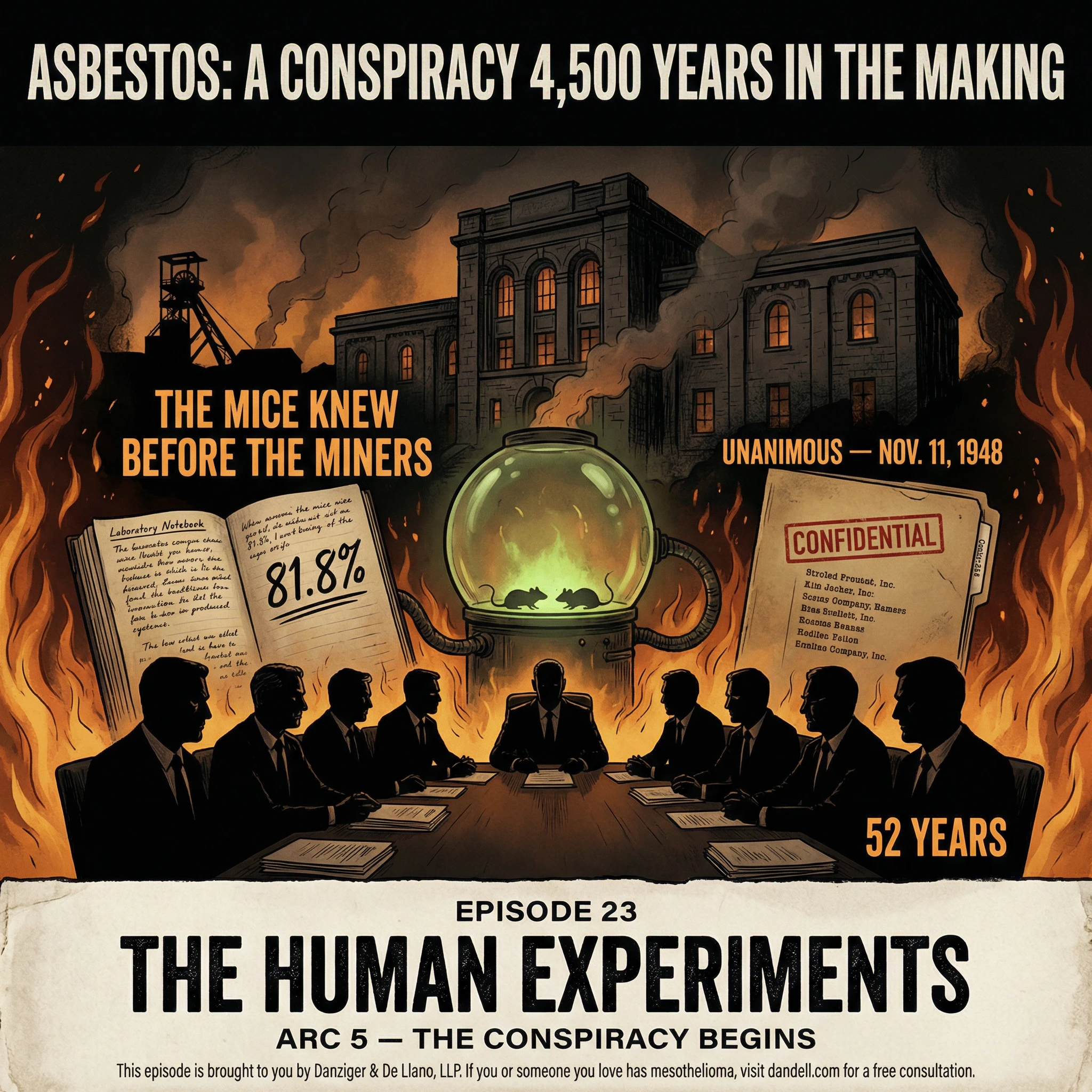
Episode 22 revealed how nine asbestos companies purchased the right to suppress science before it happened — a contract clause, a publication veto, a unanimous vote in a Manhattan boardroom. Gardner's 81.8% finding, owned by the industry that funded it, disappeared into filing cabinets in 1947. The story appeared to be a single act of corporate suppression.
Episode 23 reveals it was not.
Gardner wasn't alone. By 1960, at least six independent research teams — spanning four countries and three decades — had documented that asbestos causes cancer. Wilhelm Hueper listed it as an established carcinogen in 1942, a year before Gardner. Arthur Vorwald, who inherited Gardner's laboratory and his mouse colonies, ran a follow-up study from 1951 to 1954 using cancer-resistant mice — and still found tumors at nearly six times the background rate. He terminated the experiment before they could fully develop and said nothing for forty-one years. Kenneth Lynch, Frederick McIver, and John Cain published peer-reviewed confirmation in the AMA Archives in 1957. Christopher Wagner documented 33 mesothelioma cases in South African Cape Province in 1960. And then Wagner again, in 1974, proved that a single day of asbestos exposure is sufficient to cause fatal mesothelioma decades later.
Every study. Suppressed, buried, or ignored. While 5,000 Quebec miners went on strike in February 1949 for dust controls they didn't know would have been unnecessary if the industry had told the truth six years earlier.
Key Takeaways
- Gardner wasn't a single anomaly — he was the first of six — By 1960, independent evidence from the U.S., UK, South Africa, and Canada all pointed to the same conclusion. Each line of evidence was suppressed or ignored.
- Vorwald's 1951 study was designed not to find tumors — He used cancer-resistant mice and terminated the experiment early. His colleagues later described it as having "missed the appearance of pulmonary tumors because his experiment was terminated too soon."
- One day of exposure is enough — Wagner's 1974 rat study proved that a single 24-hour inhalation exposure to asbestos is sufficient to cause fatal mesothelioma. Two rats developed tumors and then lived a normal lifespan before dying of cancer.
- 5,000 miners struck for what industry already knew — The 1949 Quebec asbestos strike was a fight for dust controls and safety information. The proof of asbestos's lethality existed in industry files. The miners didn't have access to it.
- Gerrit Schepers waited 41 years — He found Gardner's slides in 1949, reported them, had them stolen, was reprimanded. He published the full account in 1995 — 52 years after Gardner's discovery. Five words explained his silence: "I complied thereafter in the United States."
- "The mice knew before the miners" — The thesis of Episode 23 is not a metaphor. The animals in Saranac's inhalation chambers proved asbestos causes cancer years before the miners who breathed the same dust were told anything was wrong.
The Pattern: Six Studies, Six Suppressions
Episode 22 told the story of one laboratory, one scientist, and one suppression vote. Episode 23 is the same story told six times, across three decades, with six different researchers in four countries arriving at the same conclusion — and each finding neutralized before it could reach the workers it was meant to protect.
The first wasn't even Gardner. In 1942, Wilhelm Hueper — a pathologist at DuPont's Haskell Laboratory in Newark, Delaware — published Occupational Tumors and Allied Diseases, a comprehensive textbook that listed asbestos as an established carcinogen. He was employed by an industrial company and published anyway. One year before Gardner's 81.8% finding. The industry did not respond by warning workers. It responded by commissioning its own science and purchasing the right to suppress what it found.
Independent research teams from the U.S., UK, South Africa, and Canada documented asbestos causes cancer before 1975 — every finding suppressed, buried, or ignored
Vorwald: The Successor Who Knew
Arthur Vorwald joined Saranac Laboratory as staff pathologist in 1934. He was there when Gardner designed the experiments. He was there when Gardner documented the 81.8% tumor rate in February 1943. He inherited Gardner's mouse colonies when Gardner died in October 1946. And in 1947, when he became director of the laboratory, he inherited the industry funding contract with its publication veto clause.
In 1951, Vorwald conducted his own asbestos animal study. This time, he specifically selected cancer-resistant mice — strains genetically unlikely to develop tumors. One hundred seventy-nine exposed animals, one hundred eighty-one controls. Even with mice chosen for their resistance to cancer, the chrysotile-exposed group showed a neoplasia risk ratio of 5.7 — nearly six times the tumor rate of controls. And then the experiment was "terminated too soon," in the exact phrase Vorwald's colleagues used in his Toxicological Sciences obituary. Before the tumors could fully develop. Before there would be anything definitive to report.
This study was not published until 1995 — forty-one years after Vorwald left Saranac in 1954, taking eight tons of records with him. He spent the next fourteen years as a defense expert witness in asbestos litigation.
Neoplasia risk ratio in Vorwald's 1951–1954 study — using cancer-resistant mice, deliberately chosen, terminated before tumors fully developed — suppressed until 1995
Wagner and the One-Day Finding
In October 1960, Christopher Wagner published the first definitive documentation of asbestos-caused mesothelioma: 33 cases from the Cape Province of South Africa. Twenty-two men, eleven women. Housewives who had lived near the mines. Herders who had walked through the tailings as children. The cases included people with no occupational exposure whatsoever — which meant that proximity alone, environmental exposure alone, was sufficient to cause a fatal cancer that took decades to develop. Wagner left South Africa in 1962 under industry pressure and relocated to the Pneumoconiosis Research Unit in Llandough Hospital, Wales.
In March 1974, Wagner published again. A rat study. Two animals exposed to asbestos fibers for a single 24-hour period. Then allowed to live a normal lifespan. Both developed mesothelioma. The implication — stated explicitly in the paper — was that a single day of asbestos inhalation is sufficient to cause fatal mesothelioma decades later. The latency period for mesothelioma is 20 to 50 years. Workers exposed in the 1950s and 1960s were being diagnosed in the 1980s and 1990s. Wagner's one-day finding meant that the threshold for dangerous exposure was not a career's worth of dust — it was a single shift.
A single 24-hour asbestos inhalation exposure caused fatal mesothelioma in Wagner's 1974 rat study — with animals surviving a normal lifespan before developing cancer
Schepers: The 41-Year Silence
In 1949, Gerrit Schepers arrived at Saranac Laboratory as a pathologist. Within weeks, he found Gardner's slides — the tumor-bearing mice, the documentation of 81.8%, the evidence that had been voted out of the published record two years earlier. He mentioned them to Quebec mining officials. Within a month, the slides were stolen. Arthur Vorwald reprimanded him. Schepers later summarized his response in five words: "I complied thereafter in the United States."
In 1954, Schepers became director of Saranac. He found Gardner's handwritten notes and some remaining slides. He said nothing publicly. He testified as an expert witness in asbestos litigation for decades. And in April 1995 — 52 years after Gardner's 1943 discovery, 41 years after Schepers himself became director — he published the full account in the American Journal of Industrial Medicine (PMID: 7793430). Every figure. Every date. Every suppression decision. Everything Gardner had documented and everything the nine companies had voted to erase.
No institutional force required him to keep silent for those 41 years. He described what happened as compliance. The industry didn't need a legal mechanism. The social architecture of institutional science was sufficient.
The Quebec Strike: Fighting Without the Proof
On January 12, 1949, journalist Burton LeDoux published an exposé in Le Devoir: "Asbestosis: A village of three thousand souls suffocates in dust." The article described conditions in Asbestos, Quebec — a mining town where the dust was visible in the streets, where silicosis was openly discussed, where workers had been filing complaints for years without result.
On February 13, 1949, 5,000 workers walked off the job. The strike was declared illegal by the Duplessis government. Companies continued operations with replacement workers. On May 6, 1949, 400 armed provincial police arrived. One hundred eighty miners were arrested and beaten. Archbishop Charbonneau of Montreal delivered a sermon on March 5 endorsing the strike — an unusual political act for a Catholic archbishop — and raised $500,000 plus $75,000 in food for the workers and their families. The Premier of Quebec pressured the Vatican. On February 9, 1950, Charbonneau was pressured to resign and was exiled to Victoria, British Columbia.
The strike ended on June 28, 1949, after 137 days. A partial settlement. Some wage gains. Dust controls remained inadequate. The workers had fought for health and safety information they didn't have. The proof — Gardner's 81.8% tumor rate, the November 1948 suppression vote, the stolen slides — had been locked in industry filing cabinets for years. The companies that had suppressed the cancer evidence in 1947 prevailed in the 1949 dispute.
Quebec miners struck for 137 days demanding dust controls — not knowing that proof of asbestos's lethality had been locked in industry files since 1947
Why This Matters If You Were Exposed
The pattern documented in this episode is not historical. The latency period for mesothelioma is 20 to 50 years. Workers who inhaled asbestos in the 1960s, 1970s, and 1980s — in shipyards, factories, construction sites, automotive shops, and refineries — are being diagnosed today. The science that should have protected them existed. Gardner documented it in 1943. Wagner confirmed it in 1960 and again in 1974. Every finding was available to the industry that employed those workers. None of it was shared with the workers themselves.
If you or a family member was exposed to asbestos at work and has been diagnosed with mesothelioma, the suppression documented in this episode is part of why you weren't warned. Over $30 billion remains available in asbestos trust funds for victims of occupational and secondary exposure. Danziger & De Llano has recovered nearly $2 billion for families affected by asbestos exposure over 30 years of mesothelioma litigation. A free consultation can determine whether you qualify for compensation through trust funds, litigation, or VA benefits.
Available in asbestos trust funds for victims of occupational and secondary exposure
The Timeline: Six Studies, 52 Years of Suppression
| Date | What Happened | Significance |
|---|---|---|
| 1934 | Arthur Vorwald joins Saranac Laboratory as staff pathologist | He will assist Gardner, inherit his program, and suppress the findings for four decades |
| 1942 | Wilhelm Hueper publishes Occupational Tumors and Allied Diseases, listing asbestos as an established carcinogen | First major published documentation — written by a DuPont employee, ignored by the industry |
| February 1943 | Gardner documents 81.8% malignant tumor rate — 16x higher than controls; also documents 11 human cases including 2 mesotheliomas in Quebec miners | The most significant cancer finding the asbestos industry ever funded; suppressed that same year |
| November 11, 1948 | Nine companies vote unanimously to delete all cancer references from Gardner's published report | The institutional vote that converted Gardner's findings into a 52-year gap in the scientific record |
| 1949 | Schepers finds Gardner's slides; they are stolen; he is reprimanded; he "complies" | The last person with direct access to the suppressed evidence chooses institutional silence |
| February 1949 | 5,000 Quebec miners strike for 137 days demanding dust controls | Workers fight without their most powerful weapon — the proof the industry already had |
| 1951 | Vorwald's follow-up study: cancer-resistant mice, 5.7 neoplasia risk ratio, terminated early — not published until 1995 | A deliberate study design that produced incriminating data and was then buried for four decades |
| March 1957 | Lynch, McIver, and Cain publish AMA Archives study confirming pulmonary tumors in asbestos-exposed mice | Peer-reviewed confirmation in a mainstream medical journal — ignored without consequence |
| October 1960 | Wagner documents 33 mesothelioma cases in South African Cape Province — including housewives and children | First published evidence that environmental (not just occupational) asbestos exposure causes mesothelioma |
| 1962 | Wagner leaves South Africa under industry pressure | A pattern established: researchers who publish findings face professional and personal consequences |
| March 1974 | Wagner publishes rat study: one day of asbestos exposure causes fatal mesothelioma | The threshold for dangerous exposure is not a career — it is a single shift |
| April 1995 | Schepers publishes Gardner's full findings in American Journal of Industrial Medicine (PMID: 7793430) | 52 years after Gardner's discovery — the 81.8% figure finally enters the scientific record |
Arc 5: The Conspiracy Was Never One Decision
Episode 23 is the fourth installment of Arc 5, "The Conspiracy Begins." The arc traces how asbestos suppression evolved from individual decisions into a durable system — each layer more institutional, more distributed, and more capable of surviving the removal of any single actor.
Episode 20 documented the personal layer: Sumner Simpson's private letters. Episode 21 revealed the institutional layer: trade association votes with bureaucratic cover. Episode 22 exposed the scientific layer: purchased research with contractual publication veto. Episode 23 shows the scale: suppression was not one company, one laboratory, or one vote. It was a pattern that played out across six research efforts, four countries, and three decades — with each new finding absorbed, neutralized, and buried before it could reach the workers it might have protected.
Next week, Episode 24: "The Paper Trail" — the Arc 5 finale. The documents are real. The letters are real. They kept everything.
About This Podcast
Asbestos: A Conspiracy 4,500 Years in the Making is a 52-episode documentary podcast series produced by Danziger & De Llano, LLP. The series traces the complete history of asbestos — from 4700 BCE to the 2024 EPA ban — revealing how a substance known for millennia as the "Magic Mineral" became one of history's deadliest industrial cover-ups.
Each episode combines archival research, historical analysis, and modern medical and legal context to document how corporations suppressed evidence of asbestos danger while workers and families died. Over 30 years, Danziger & De Llano has recovered nearly $2 billion for families affected by asbestos exposure. If you or a family member was exposed to asbestos and have questions about mesothelioma, compensation, or your legal rights, visit dandell.com for a free consultation.
The Asbestos Podcast is part of the MESO podcast network, dedicated to education and advocacy for mesothelioma victims and their families.
The complete episode transcript with citations, key facts, and additional context is available on WikiMesothelioma.com — our open educational resource for asbestos and mesothelioma information.
Meet the Team Behind This Episode

Founding Partner, Danziger & De Llano
Founding Partner at Danziger & De Llano with over 30 years of mesothelioma litigation experience. Co-executive producer of Puncture (2011).

Founding Partner, Danziger & De Llano
Founding Partner at Danziger & De Llano. Former Jones Day corporate defense attorney who switched sides after seeing firsthand what asbestos companies did to workers. Over $1 billion recovered for mesothelioma families.
Senior Client Advocate, Danziger & De Llano
Senior Client Advocate and Military Veteran Specialist at Danziger & De Llano. His father, Dan Gates, died of mesothelioma after working at a Shell refinery in Pasadena, Texas. Larry has dedicated his career to helping families like his.
Related Resources
Topics
Were You or a Loved One Exposed to Asbestos?
The history in this episode isn't just history. If you worked with asbestos products, lived in a home built with asbestos materials, or were exposed through a family member's work clothes, you may have legal options. Danziger & De Llano has spent 30+ years and recovered nearly $2 billion for asbestos victims.