What This Episode Covers
Episode 20 revealed the personal letters — Sumner Simpson writing to Vandiver Brown, competitors coordinating suppression strategy in their own handwriting. But personal letters have a weakness: they depend on individual executives making individual choices to suppress information. What happens when one of them retires? Changes his mind? Gets a conscience? The system breaks down. Episode 21 reveals how the asbestos industry solved that problem by building institutions.
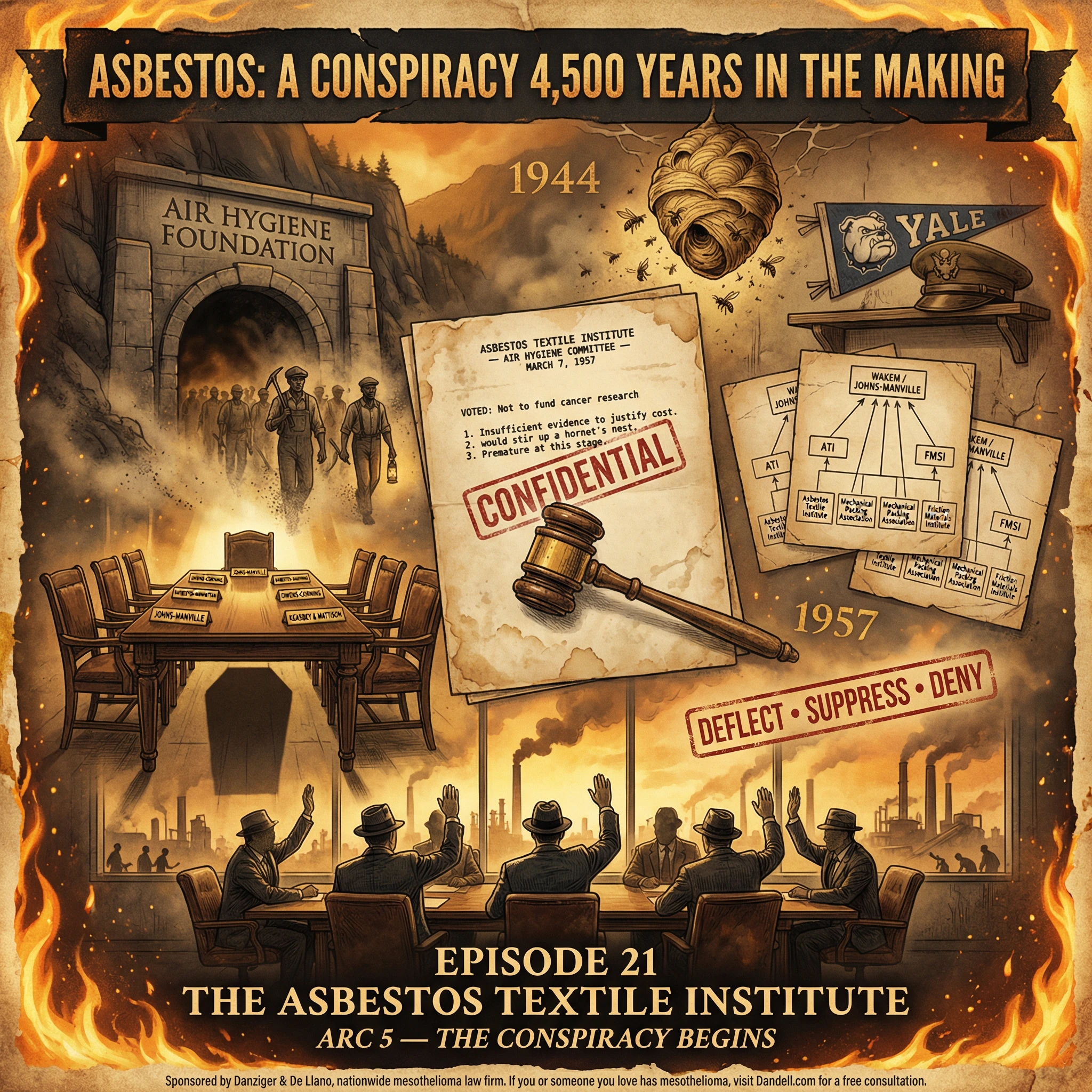
The Asbestos Textile Institute was founded in 1944 — a formal trade association with committees, bylaws, meeting minutes, and votes. By the time the ATI's Air Hygiene Committee met on March 7, 1957, suppression didn't require a personal letter from one executive to another. It required a vote. Six companies sat around a table and voted not to fund cancer research. They documented three reasons: someone else was already studying it, it would "stir up a hornet's nest," and there wasn't enough evidence. The minutes were typed, distributed, and filed. The system had been institutionalized.
And the man who ran the system — Francis Wakem, Yale-educated, World War I veteran, Vice President at Johns-Manville — simultaneously controlled three trade associations. He didn't even need to be in the room for the March 7 vote. The machinery he built ran itself.
Key Takeaways
- Suppression moved from personal letters to institutional votes — The ATI transformed ad hoc executive conspiracy into formal committee process with documented votes, meeting minutes, and bureaucratic structure.
- Six companies voted not to fund cancer research — On March 7, 1957, the ATI Air Hygiene Committee unanimously rejected a proposal to study asbestos and cancer, citing three reasons: deflect, suppress, deny.
- "Stir up a hornet's nest" — The ATI's own minutes documented that funding cancer research would draw unwanted attention to the asbestos-cancer link they were trying to hide.
- One man ran three trade associations — Francis Wakem of Johns-Manville simultaneously controlled the ATI, the Mechanical Packing Association, and FMSI, ensuring J-M directed industry-wide suppression policy.
- The Hawks Nest disaster created the tool the asbestos industry co-opted — 764 workers died at Gauley Bridge (1930-1931), leading to the creation of the Industrial Hygiene Foundation — which the asbestos industry then hired to manage its own health research.
- The conspiracy had three layers — Personal letters (1930s), trade associations (1940s-1950s), and co-opted research institutions — each layer making suppression more systematic and harder to dismantle.
The March 7, 1957 Vote
The ATI's Air Hygiene Committee met on March 7, 1957. The agenda included a proposal to fund research into the relationship between asbestos exposure and cancer. By 1957, the evidence was mounting — Dr. Richard Doll had published his landmark study linking asbestos to lung cancer in 1955. The question wasn't whether asbestos caused cancer. The question was whether the industry would investigate its own products.
Six companies voted. The vote was unanimous: no funding. The minutes recorded three reasons. First, someone else was already studying the problem — a classic deflection. Let another organization spend the money and take the heat. Second, funding cancer research would "stir up a hornet's nest" — their exact words, preserved in their own minutes. Studying cancer meant acknowledging cancer was worth studying, and that acknowledgment could be used against them in court. Third, there was "not enough evidence" to justify the expense — a denial that contradicted two decades of accumulating medical literature.
Deflect. Suppress. Deny. Three reasons, documented in the industry's own handwriting, in minutes distributed to every member company. This wasn't a back-channel conversation between two executives. This was institutional policy, voted on and recorded.
Voted unanimously on March 7, 1957 not to fund cancer research — documenting their reasons in official ATI minutes
The Man Who Ran Three Trade Associations
Francis Wakem graduated from Yale and served in World War I before joining Johns-Manville, where he rose to Vice President. But his real power wasn't his corporate title — it was his simultaneous control of three asbestos trade associations: the Asbestos Textile Institute, the Mechanical Packing Association, and the Friction Materials Standards Institute (FMSI). Each association represented a different segment of the asbestos industry. Wakem ran all three.
This meant Johns-Manville — already the largest asbestos company in the world — effectively controlled the trade association infrastructure for the entire American asbestos industry. When the ATI voted on research funding, Wakem's influence shaped the agenda. When the Mechanical Packing Association set industry standards, Wakem's priorities determined what was studied and what was ignored. When FMSI addressed friction materials — brake pads, clutch facings, the products that exposed millions of auto mechanics — Wakem decided what safety information reached the workers.
The system was so thoroughly institutionalized that by March 7, 1957, Wakem didn't need to be in the room for the vote. The committees he built, the agendas he set, the culture of suppression he institutionalized — it all ran without him. He died in 1960, at age 63. The trade associations continued suppressing research for decades after his death.
Simultaneously controlled by one Johns-Manville executive — ensuring the largest asbestos company directed industry-wide health policy
The Hawks Nest Connection
To understand how the asbestos industry co-opted industrial health research, you have to go back to a tunnel in West Virginia. In 1930, Union Carbide subsidiary New Kanawha Power Company began drilling a three-mile tunnel through Hawk's Nest Mountain near Gauley Bridge to divert the New River for hydroelectric power. The workers — most of them Black men recruited from the South with promises of jobs during the Depression — drilled through rock that was nearly pure silica.
They drilled dry, without water suppression, without respirators, without ventilation. Silica dust filled the tunnel like fog. Workers began dying within months — not the slow progression of chronic silicosis, but acute silicosis, lungs filling with glass-like particles so quickly that men went from healthy to dead in under a year. An estimated 764 workers died. Many were buried in unmarked graves on the property of a local undertaker who had a contract with the company. Congressional hearings followed in 1936, and the disaster became a national scandal.
Out of Hawks Nest came the Air Hygiene Foundation — later renamed the Industrial Hygiene Foundation — an organization created to study industrial dust diseases and prevent another mass casualty event. It was supposed to be the institutional safeguard. Instead, the asbestos industry hired it. The organization born from one industrial disaster became a tool for concealing another. The ATI contracted with the Industrial Hygiene Foundation to conduct asbestos health studies — studies whose scope, methodology, and publication the industry could influence through its trade association funding.
Workers killed at Hawks Nest tunnel (1930-1931) — mostly Black men recruited from the South. The disaster created the institution the asbestos industry later co-opted.
Why This Matters If You Were Exposed
The documents from the ATI meetings — the votes, the minutes, the three documented reasons for refusing to fund cancer research — prove that suppression was not the act of rogue executives. It was institutional policy. Trade associations gave the asbestos industry a way to collectively decide to keep workers in the dark about cancer risk, and to document those decisions in minutes that would survive for decades.
The latency period for mesothelioma is 20-50 years from first exposure. Workers who handled asbestos textiles, brake pads, packing materials, and insulation products in the 1960s, 1970s, and 1980s are being diagnosed with mesothelioma today. The ATI minutes from 1957 — proving the industry voted not to study the cancer its products caused — are among the most powerful documents in mesothelioma litigation. Over $30 billion remains available in asbestos trust funds for victims of occupational and secondary exposure.
If you or a family member was exposed to asbestos at work — in textile mills, automotive shops, shipyards, construction sites, or industrial facilities — the conspiracy documented in these trade association minutes is why you weren't warned. Danziger & De Llano has recovered nearly $2 billion for families affected by asbestos exposure. A free consultation can determine whether you qualify for compensation through trust funds, litigation, or VA benefits.
Available in asbestos trust funds for victims of occupational and secondary exposure
The Timeline: From Trade Association to Institutional Suppression
| Year | What Happened | Significance |
|---|---|---|
| 1930–1931 | Hawks Nest tunnel disaster — 764 workers dead at Gauley Bridge, WV | Mostly Black workers recruited from the South; leads to congressional hearings and creation of Air Hygiene Foundation |
| 1935 | Sumner Simpson writes "the less said about asbestos, the better" | Personal executive letters — the first layer of conspiracy (Episode 20) |
| 1936 | Air Hygiene Foundation established after Hawks Nest hearings | Created to prevent industrial dust disasters — later co-opted by asbestos industry |
| 1944 | Asbestos Textile Institute founded | Formal trade association with committees, bylaws, and votes — institutionalizes suppression |
| Late 1940s | Francis Wakem takes control of ATI, Mechanical Packing Association, and FMSI | One Johns-Manville executive controls three trade associations — J-M directs industry-wide policy |
| 1950s | Air Hygiene Foundation renamed Industrial Hygiene Foundation | ATI contracts with IHF for asbestos health research — the organization born from Hawks Nest now serves the asbestos industry |
| 1955 | Dr. Richard Doll publishes landmark study linking asbestos to lung cancer | Medical evidence of asbestos-cancer link is now in the scientific literature |
| March 7, 1957 | ATI Air Hygiene Committee votes not to fund cancer research | Six companies, three documented reasons: deflect, suppress, deny. Institutional suppression in official minutes. |
| 1960 | Francis Wakem dies at age 63 | The system he built continues without him — trade associations suppress research for decades more |
Arc 5: The Conspiracy Builds
Episode 21 is the second installment of Arc 5, "The Conspiracy Begins." Episode 20 showed us the personal layer — Simpson and Brown writing letters to each other, coordinating suppression between two competitors. Episode 21 reveals the institutional layer — trade associations with committees and votes, turning individual conspiracy into organizational policy. The pattern is clear: each decade, the suppression becomes more systematic. More bureaucratic. Harder to trace to any single decision-maker.
Next week, Episode 22 examines "The Saranac Coverup" — how the asbestos industry's relationship with a prestigious research laboratory produced science designed to protect corporations rather than workers. The third layer of the conspiracy: co-opted research institutions producing industry-friendly results while workers continued to die.
About This Podcast
Asbestos: A Conspiracy 4,500 Years in the Making is a 52-episode documentary podcast series produced by Danziger & De Llano, LLP. The series traces the complete history of asbestos — from 4700 BCE to the 2024 EPA ban — revealing how a substance known for millennia as the "Magic Mineral" became one of history's deadliest industrial cover-ups.
Each episode combines archival research, historical analysis, and modern medical and legal context to document how corporations suppressed evidence of asbestos danger while workers and families died. Over 30 years, Danziger & De Llano has recovered nearly $2 billion for families affected by asbestos exposure. If you or a family member was exposed to asbestos and have questions about mesothelioma, compensation, or your legal rights, visit dandell.com for a free consultation.
The Asbestos Podcast is part of the MESO podcast network, dedicated to education and advocacy for mesothelioma victims and their families.
The complete episode transcript with citations, key facts, and additional context is available on WikiMesothelioma.com — our open educational resource for asbestos and mesothelioma information.
Meet the Team Behind This Episode

Executive Director of Patient Advocacy, Danziger & De Llano
Executive Director of Patient Advocacy with 18 years of experience helping mesothelioma families. Lost his father to asbestos lung cancer — his father was a dentist who also ran the family masonry business, mixing asbestos into mortar with his bare hands.

Founding Partner, Danziger & De Llano
Founding Partner at Danziger & De Llano with over 30 years of mesothelioma litigation experience. Co-executive producer of Puncture (2011).
Related Resources
Topics
Were You or a Loved One Exposed to Asbestos?
The history in this episode isn't just history. If you worked with asbestos products, lived in a home built with asbestos materials, or were exposed through a family member's work clothes, you may have legal options. Danziger & De Llano has spent 30+ years and recovered nearly $2 billion for asbestos victims.