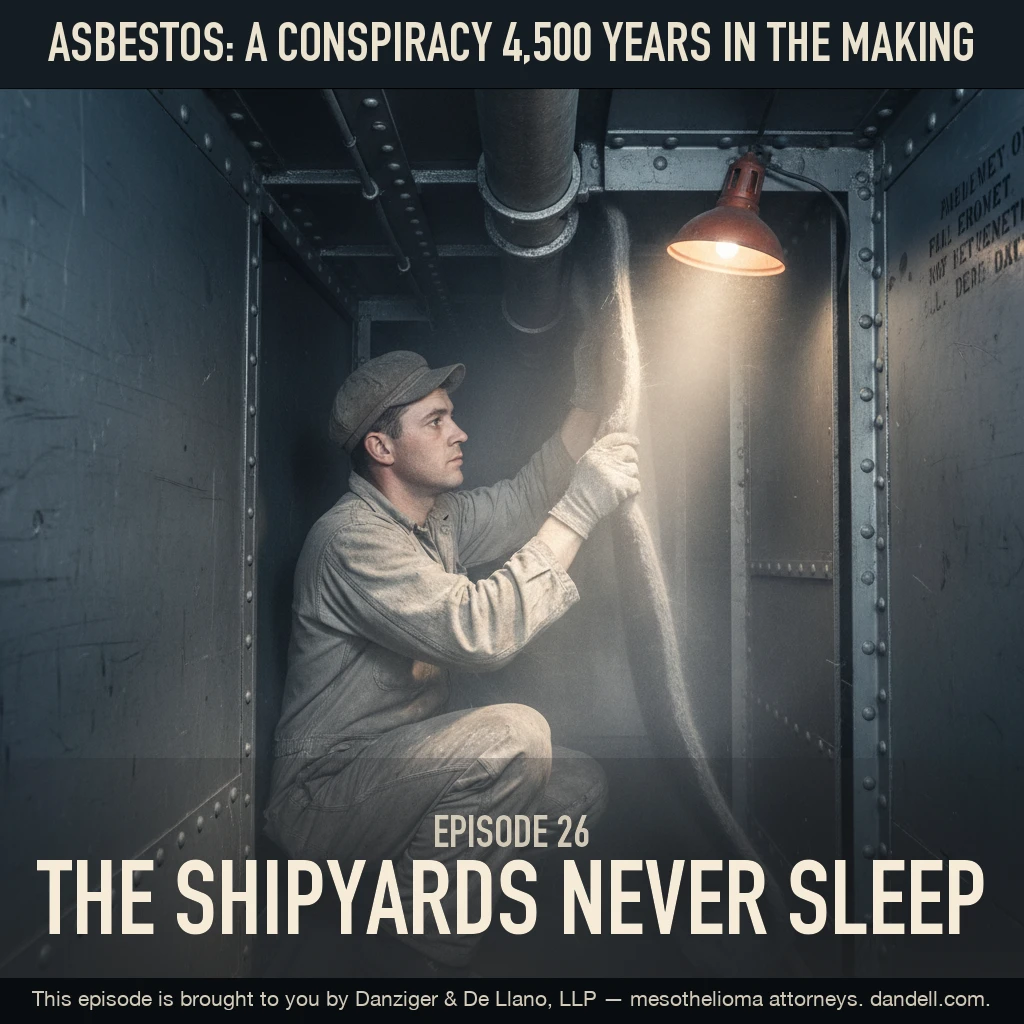
What This Episode Covers
December 1941. Brooklyn Navy Yard. Howard Zinn is nineteen years old — an apprentice shipfitter on his first day. He described it decades later in an oral history interview: "The first time I walked out on the ways, I was walking into a kind of nightmare of sounds, noise, and smells." He described the heat, the salt pills in summer, and the four-by-four-by-four-foot compartments — accessible only through a small hole in the hull — where workers built the fleet that won the war.
That is where 1.7 million Americans breathed dust that wouldn't kill them for twenty years.
Episode 26 goes inside the shipyards during peak wartime production. Three shifts, twenty-four hours a day, seven days a week. An Iowa-class battleship containing 465 long tons of asbestos insulation. A 1944 Navy Bureau of Medicine letter documenting dust concentrations as "a dangerous hazard to personnel" — a letter that never reached the workers on the floor. And Clarence Borel — insulation worker, thirty-three years, lawsuit that changed asbestos law — who thought the dust dissolved when he breathed it. Like sugar in water.
Key Takeaways
- 465 long tons of asbestos insulation per Iowa-class battleship. Eighty-five thousand to ninety thousand pounds per destroyer. Over 5,500 vessels built 1939–1945. Every one packed with asbestos. Every one built by workers who had no idea what they were breathing.
- Three shifts. Twenty-four hours. Seven days a week. At Brooklyn Navy Yard, 70,000 workers per day at peak production. By 1942, 40% of workers were logging more than 48 hours a week. The time-weighted averages later used to define "safe" exposure were meaningless for workers in it 60–70 hours a week.
- Every trade was exposed. Pipe coverers handled 85–95% asbestos felt. Welders wore asbestos gloves, aprons, leggings, and blankets. Boilermakers worked in compartments where insulators had just been. Electricians handled asbestos wire insulation. Carpenters cut asbestos-cement Transite board. Court records: "Asbestos was essentially everywhere."
- The 1944 Navy Bureau of Medicine letter. Dust counts during amosite insulation application were "well above the accepted maximum of eight million particles per cubic foot." Their written conclusion: "a dangerous hazard to personnel." This was 1944, while 1.7 million workers labored in those conditions. The letter went to supervisors. Not to workers.
- Clarence Borel's testimony: "blowed this dust out of my nostrils by handfuls." Thirty-three years of exposure. He thought it was "bothersome." He "never realized it could cause any serious or terminal illness." He believed the dust "dissolves as it hits your lungs." He learned the truth in January 1969. He died June 3, 1970 — four months later. His case became Borel v. Fibreboard.
- The information gap. 1930: British science establishes asbestos causes asbestosis. 1941: Stephenson warns the Surgeon General "we are not protecting the men as we should." 1944: Navy documents "dangerous hazard to personnel." Workers' knowledge throughout: the dust dissolves.
- 30% of all mesothelioma diagnoses are veterans. Nearly 1,000 shipyard and Navy cases annually. The 20–50 year latency clock meant executives who signed the 1944 memos were retired before the workers they managed started dying. Cases from 1940s wartime exposure are still being diagnosed today.
Inside the Yards: Three Shifts and No Clock-Out for Dust
After Pearl Harbor, American shipyards stopped sleeping. Three shifts, twenty-four hours a day, seven days a week, for the duration. At Brooklyn Navy Yard, 70,000 workers reported for duty each day at peak production. Bureau of Labor Statistics records show that by 1942, forty percent of Brooklyn Navy Yard workers were logging more than forty-eight hours a week. Roosevelt extended working hours for war industries in February 1943.
A day-shift worker might enter a compartment that had been filled with asbestos dust by the night shift — and by the swing shift before that. The dust didn't clock out. It accumulated. The time-weighted averages that industrial hygienists would later use to calculate "safe" occupational exposure were built for eight-hour days in measured conditions. They were meaningless for workers breathing asbestos dust for sixty or seventy hours a week in spaces the Navy's own medical officers described as too dusty to see across.
Shipyard workers at peak production, December 1943 — the largest industrial workforce America had ever assembled, all working with asbestos, three shifts a day
What Every Trade Breathed
Pipe coverers and insulators had the highest measured exposure. They handled felt insulation that was 85 to 95 percent asbestos by content — applying it to pipes, boilers, and turbines by hand, cutting it with band saws, mixing it in rooms where the air turned white. Dr. Philip Drinker, Harvard professor and Chief Health Consultant to the Navy, surveyed dedicated pipe-covering shops at Bath Iron Works in Maine in 1944 and found workers cutting and pounding asbestos matting in conditions that created "a very real asbestos hazard."
But exposure did not stop at the pipe coverers. Boilermakers worked in the confined compartments where insulators had just been, or where they were working alongside them. Court testimony in asbestos litigation describes it plainly: "In the naval shipyards, workers of all trades in small compartments breathed the heavy asbestos dust created by insulators and boilermakers." Welders wore asbestos-based protective equipment — gloves, aprons, leggings, blankets used as fire shields — while working next to freshly-applied insulation. Electricians handled asbestos wire insulation and electrical tape. Carpenters cut asbestos-cement Transite board. Machinists worked with asbestos brake and clutch materials and gaskets. The accumulated result, documented in court records: "Asbestos was essentially everywhere."
Thermal insulation per Iowa-class battleship — nearly all asbestos, plus 85,000–90,000 lbs per destroyer, across 5,500+ ships built between 1939 and 1945
The 1944 Letter That Never Reached the Workers
In 1944, Dr. Philip Drinker reported to the Navy Bureau of Ships that dust counts at Bath Iron Works were "very much higher than anyone would recommend." The Navy Bureau of Medicine conducted its own dust counts during application of amosite felt insulation on board ships. Their finding: concentrations "well above the accepted maximum of eight million particles of dust per cubic foot." The U.S. Public Health Service had established five million particles per cubic foot as the safe threshold in 1938. The Navy used eight million. The shipboard measurements exceeded even that elevated standard.
The Bureau of Medicine's conclusion, in a 1944 letter to the Supervisor of Shipbuilding: "a dangerous hazard to personnel."
That letter went up the chain. The workers on the shipyard floor never saw it. The memos went to supervisors and bureau chiefs. The men crawling into four-by-four-by-four compartments — building the fleet, breathing the dust — got nothing.
Clarence Borel: Thirty-Three Years and Four Months
Clarence Borel worked as an industrial insulation worker for thirty-three years, from 1936 to 1969, at shipyards and refineries along the Texas-Louisiana border. His deposition testimony — given under oath in the case that would become Borel v. Fibreboard Paper Products Corporation — describes what he believed about the dust he breathed every day.
"You just move them just a little and there is going to be dust, and I blowed this dust out of my nostrils by handfuls at the end of the day." He tried water. He used Mentholatum in his nostrils. He knew it was "bothersome." He knew he was breathing it. What he didn't know — what no one had ever told him — was what it was doing to him. He testified that he "never realized it could cause any serious or terminal illness." When asked what he believed happened to the asbestos dust once he breathed it in, Borel said he thought it "dissolves as it hits your lungs."
Like sugar in water. That's what thirty-three years of daily asbestos exposure looked like from the inside, from the perspective of the man breathing it. The dust coating his lungs, embedding in his tissue, starting the two-decade clock toward mesothelioma — and he thought it dissolved.
Borel was hospitalized with breathing problems in January 1969. In February 1970, surgeons removed his right lung and found mesothelioma. He died June 3, 1970 — four months after learning what the dust had actually done. The Fifth Circuit Court of Appeals decided his case in 1973, establishing manufacturer liability for failure to warn of known asbestos hazards. Borel v. Fibreboard is the foundation of asbestos personal injury law. Clarence Borel did not live to see the decision.
Of all mesothelioma cases in the United States involve veterans — a direct consequence of asbestos use aboard every Navy combat vessel built during and after World War II
The Information Gap: What Officials Knew, What Workers Believed
Put the two timelines side by side. The official record: 1930, British science establishes that asbestos causes asbestosis. 1938, the U.S. Public Health Service sets a five-million-particle safe limit. 1941, Commander Stephenson warns Surgeon General McIntire that "we are not protecting the men as we should." 1944, the Navy Bureau of Medicine documents shipboard dust concentrations as "a dangerous hazard to personnel."
The workers' record: the dust is "bothersome." The dust dissolves. Nobody said it could kill you.
The information gap between those two timelines is not accidental. Navy medical officers documented hazards in internal memos that went up the chain of command and stopped there. The Stephenson memo produced no written response. The 1944 dangerous-hazard letter produced no worker notification. The system was designed — or allowed — to contain the information at the supervisory level. Workers on the shipyard floor were left with what they could observe themselves and what they were told, which was nothing.
The latency clock did the rest. Twenty to fifty years between asbestos exposure and mesothelioma diagnosis. Workers exposed in 1943 wouldn't develop disease until 1963 at the earliest. The executives who signed the 1944 memos were retired or dead before the workers they managed started dying. The paper trail was buried in corporate and government archives. And when the workers started getting sick in the 1960s and 1970s, wondering why they couldn't breathe, the documentation of what officials had known was nowhere near the shipyard floor where it would have mattered.
The shipyards built the fleet that won the war. And they poisoned a generation.
If You or a Family Member Served in the Navy or Worked in a Shipyard
Nearly 30% of mesothelioma diagnoses in the United States involve veterans. The exposure happened decades ago — but mesothelioma's latency period means cases from wartime and postwar Navy service are still being diagnosed today.
Veterans with mesothelioma qualify for VA disability benefits, Priority Group 1 healthcare at no cost, and the VA Caregiver Support Program — all running concurrently with civil legal claims. VA benefits do not reduce trust fund or lawsuit recoveries.
Over $30 billion remains available in asbestos bankruptcy trust funds. Navy veterans and shipyard workers may qualify to file claims against multiple trusts simultaneously. Average mesothelioma settlements range from $1 million to $2.4 million.
For a free consultation, Danziger & De Llano has recovered nearly $2 billion for mesothelioma families. Larry Gates, Senior Client Advocate and Military Veteran Specialist, works specifically with veteran families and has personal experience with what these cases cost. The book Beating the Odds: Surviving Mesothelioma, compiled by Dave Foster at Danziger & De Llano, is available free — call the firm directly.
About This Podcast
Asbestos: A Conspiracy 4,500 Years in the Making is a 52-episode documentary podcast series produced by Danziger & De Llano, LLP. The series traces the complete history of asbestos — from 4700 BCE to the 2024 EPA ban — revealing how a substance known for millennia as the "Magic Mineral" became one of history's deadliest industrial cover-ups.
Each episode combines archival research, historical analysis, and modern medical and legal context to document how corporations and institutions suppressed evidence of asbestos danger while workers and families died. Over 30 years, Danziger & De Llano has recovered nearly $2 billion for families affected by asbestos exposure. If you or a family member was exposed to asbestos and have questions about mesothelioma, compensation, or your legal rights, visit dandell.com for a free consultation.
The complete episode transcript with citations, key facts, and additional context is available on WikiMesothelioma.com — our open educational resource for asbestos and mesothelioma information.
Meet the Team Behind This Episode
Senior Client Advocate & Military Veteran Specialist, Danziger & De Llano
Senior Client Advocate and Military Veteran Specialist at Danziger & De Llano. His father died of mesothelioma after years at the Shell refinery in Pasadena, Texas. Larry is seventy-two and currently fighting his own battle with cancer. When he talks to veteran families, he brings both professional expertise and personal understanding to every conversation.
Related Resources
Topics
Were You or a Loved One Exposed to Asbestos?
The history in this episode isn't just history. If you worked with asbestos products, lived in a home built with asbestos materials, or were exposed through a family member's work clothes, you may have legal options. Danziger & De Llano has spent 30+ years and recovered nearly $2 billion for asbestos victims.