What This Episode Covers
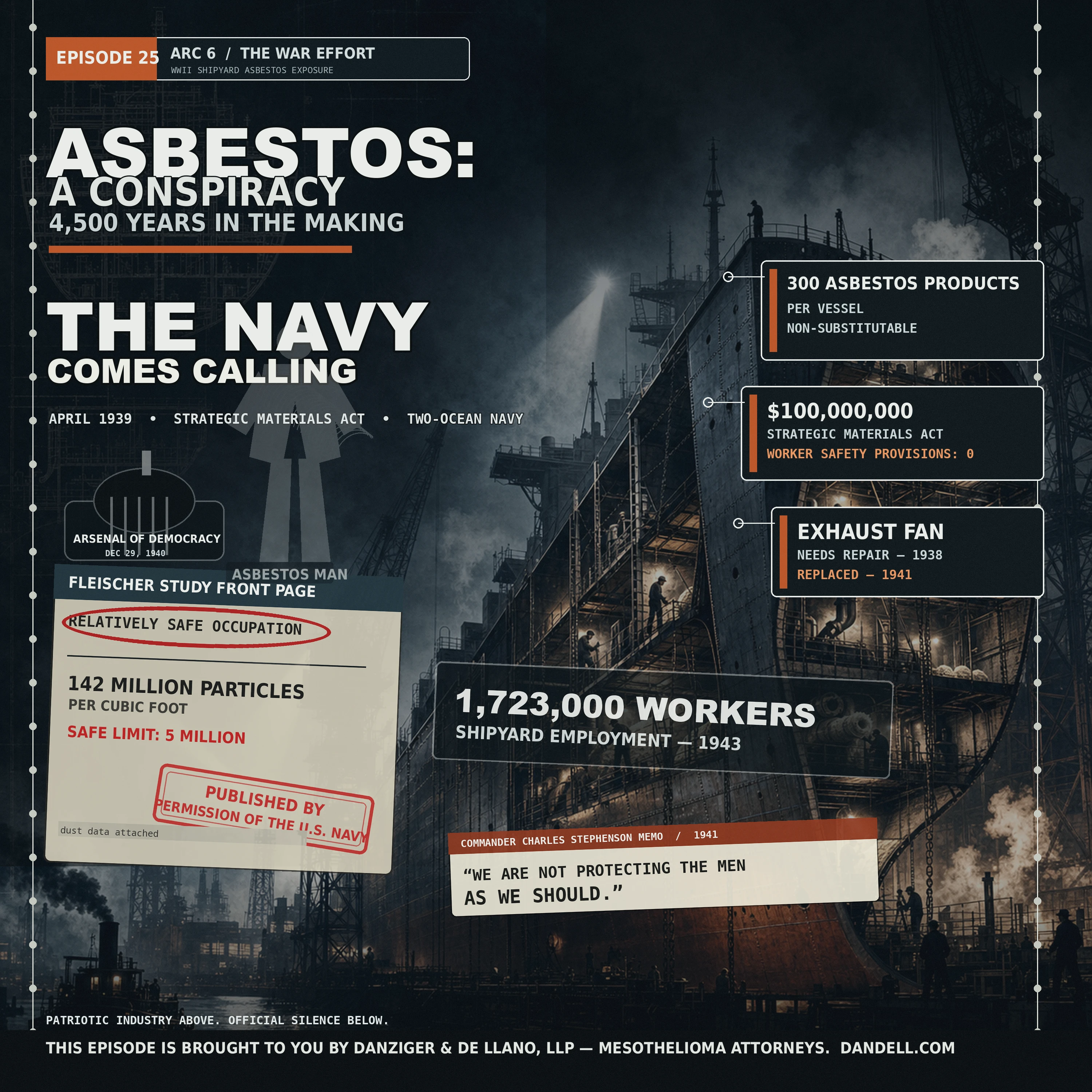
April 1939. Flushing Meadows, Queens. At the New York World's Fair, Johns-Manville's centerpiece exhibit is a muscled superhero called Asbestos Man, wrestling fire while children line up for photographs. The brochures call asbestos "the magic mineral." At that same moment, Vandiver Brown — Johns-Manville's chief counsel — is managing the Saranac Laboratory coverup: suppressing the studies that show asbestos kills the workers who handle it.
Two months later, Congress passes the Strategic Materials Act, authorizing $100 million to stockpile asbestos for a war not yet entered. The Congressional Record shows zero worker safety language across every page of the floor debate and every amendment offered. The hazard was known. The Act didn't address it.
Episode 25 opens Arc 6 — the war years — by tracing how the Navy's own internal record reveals three things happening simultaneously: rapid, massive industrial buildup; documented knowledge of the asbestos hazard; and an institutional decision not to act on that knowledge.
Key Takeaways
- June 7, 1939 — Strategic Materials Act. Signed by President Roosevelt. $100 million to stockpile asbestos, rubber, tin, chromium. Zero worker safety language in the entire floor record — despite decades of documented evidence that asbestos causes fatal lung disease.
- The Navy yard workforce nearly quadrupled in 18 months. Brooklyn Navy Yard: 9,195 workers (October 1939) → 27,258 (October 1941). Nationally: 168,000 (June 1940) → 656,000 (December 1941) → 1.7 million (December 1943). Every one of them worked with asbestos.
- ~300 asbestos products per vessel. The 1944 War Production Board described asbestos textiles as "a non-substitutable component in all combat vessels." There was no substitute. The fleet would be built with asbestos or it would not be built.
- The "1922 Navy knew" claim is a myth. The Naval Medical Bulletins cited are digitized. No article on asbestos exists. A 2011 peer-reviewed study confirmed no U.S. government documents addressed asbestos hazards before 1929. The first verified Navy document is the 1939 Jenkins memo.
- The Fleischer study: 142 million particles per cubic foot, conclusion "relatively safe." Twenty-eight times the established safe limit. The explanation: 95% of workers studied had less than 10 years of exposure. Asbestosis takes 10–25 years to develop. They weren't sick yet. The Fifth Circuit called this conclusion "misleading" in Borel v. Fibreboard.
- The Stephenson memo, March 1941. Commander Stephenson to Surgeon General McIntire: "I am certain that we are not protecting the men as we should. This is a matter of official report from several of our Navy Yards." No written response is in the record. The Navy inspected itself. A federal court later called the arrangement "official connivance at a coverup."
- Admiral McIntire was selected for his ability to "keep a close mouth." The Surgeon General receiving the memo warning about asbestos in the yards was also FDR's personal physician — recommended for the post for his discretion. The President received daily visits from the man who received the warning and did not respond.
The World's Fair, the Stockpile, and the Floor Record
The 1939 World's Fair ran for two seasons and drew 44 million visitors. Johns-Manville's pavilion — seventeen acres — featured Asbestos Man as its centerpiece attraction. The character was a muscled superhero in a fireproof suit, wrestling fire into submission. Children lined up for photographs. The brochures were explicit: asbestos was "the magic mineral." At the same pavilion, company representatives talked about asbestos's future in American industry.
Vandiver Brown — Johns-Manville's general counsel, vice president, and corporate secretary — was simultaneously managing the suppression of the Saranac Laboratory research: the studies documenting that asbestos killed workers, which were being edited and rewritten before publication under company direction. We covered this in Arc 5. The same boardroom. The same month. One strategy for the public; a different one for the files.
Two months after the World's Fair opened, Congress passed the Strategic Materials Act. Senator Elbert Thomas of Utah introduced it. Roosevelt signed it June 7, 1939. One hundred million dollars to stockpile strategic materials: rubber, tin, chromium, asbestos. By October 1940, twenty thousand short tons of asbestos had been allocated. The research for this episode included reading every page of the Congressional Record for the floor debate — April 27 through May 11, 1939, every amendment offered.
There is no worker safety language. Not one amendment. Not one senator who stood up and said: if we're going to mine and mill and weave this much asbestos, we should think about the men handling it. The hazard had been documented for decades by that point. It was not unknown. The Act simply didn't address it.
Shipyard workers in the United States by December 1943 — the largest industrial workforce America had ever assembled, all working with asbestos
The Buildup and What Went Into Every Ship
The Two-Ocean Navy Act, signed July 19, 1940, authorized four billion dollars: seven battleships, eighteen aircraft carriers, one hundred fifteen destroyers, 1.325 million tons of new ships. To build that fleet, the Navy needed workers — and it needed asbestos.
A 1944 War Production Board memo described asbestos textiles as "a non-substitutable component in all combat vessels." Approximately 300 different asbestos-containing products went into each ship: pipe insulation, boiler lagging, gaskets, bulkhead panels, electrical cloth, brake linings. There was no alternative. The Navy was building a fleet that could only be built with asbestos.
Brooklyn Navy Yard in October 1939: 9,195 workers. By January 1941, the Brooklyn Daily Eagle headline read "Boro Navy Yard Employment at Peak of 20,200." By October 1941: 27,258. Nationally, the shipyard workforce went from 168,000 in June 1940 to 656,000 by December 1941 — nearly four times the workforce in eighteen months — and reached 1.7 million by December 1943.
The inspection record for that buildup is sparse. One documented inspection: February 4, 1938. Building 10, Brooklyn Navy Yard. Inspector William Stewart finds workers mixing magnesia and fiber for insulation, breathing through half-mask respirators. He notes the exhaust fan "sparked excessively and needed repair" and was "too small." The fan was replaced in September 1941 — three and a half years later, while the workforce in that yard tripled.
The 1922 Myth and What the Navy Actually Knew
The claim that "the Navy knew about asbestos as early as 1922" appears frequently in mesothelioma litigation materials and veteran advocacy resources. The sourcing traces to the U.S. Naval Medical Bulletin, Volumes 16 and 17. Those bulletins are digitized. The tables of contents are public.
There is no article on asbestos. There is no article on occupational dust hazards. The 1922 Navy Medical Bulletin entry on asbestos does not exist. A 2011 peer-reviewed article in Inhalation Toxicology stated it directly: "No documents from the Navy or other US government agencies were identified" addressing asbestos hazards from 1900 to 1929. Every source that cites the 1922 date cites another source. At the bottom of the chain: nothing.
The first verified Navy document is from 1939. H.E. Jenkins, Medical Officer, U.S. Navy, memo to the manager of the Boston Navy Yard, recommending respirators and protective gloves and specifying that amosite "should be kept sufficiently moist at all times." By 1939, the Navy's own medical officers were putting asbestos protection requirements in writing.
In 1941, Captain Ernest Brown of the Navy Medical Corps surveyed workers at the New York Navy Yard and found no cases of asbestosis. In September of the same year, a separate study at the same location concluded: "The conditions in this shop present a very real asbestosis hazard and immediate steps should be taken." Two studies. Same location. Same year. One finds no problem. One finds a very real hazard. That is the Navy's record on its own desks in 1941.
The Fleischer Study: 28× the Safe Limit, Conclusion "Relatively Safe"
The study the Navy used as its public defense for the next three decades was the Fleischer study: "A Health Survey of Pipe Covering Operations in Constructing Naval Vessels," Journal of Industrial Hygiene and Toxicology, 1946. The data was collected during the war. 1,074 pipe coverers examined. Three cases of asbestosis found — each in a worker with more than twenty years of exposure.
The dust measurements those workers were breathing: band saw cutting, up to 73 million particles per cubic foot. Cement mixing, up to 84 million. Installation on board ship, up to 142 million particles per cubic foot. The established safe threshold was 5 million. That is 28 times the limit.
The paper's conclusion: "Since only three workers out of the one thousand seventy-four X-rayed had asbestosis, it would appear that asbestos pipe covering of naval vessels is a relatively safe occupation."
The safe asbestos dust limit exceeded in Navy shipyard compartments — 142 million particles per cubic foot measured, versus a 5-million threshold — in a study that concluded the work was "relatively safe"
The explanation is in the data the authors reported without appearing to notice: 95% of the workers they examined had been at the trade for fewer than ten years. Asbestosis takes 10 to 25 years to become diagnosable. Fleischer was looking for a disease in workers who hadn't been exposed long enough to develop it yet. He didn't find it. And he called the job safe.
The Fifth Circuit Court of Appeals, in Borel v. Fibreboard (1973), called the "safe occupation" conclusion "misleading." The front page of the study reads "Published by permission of the U.S. Navy." Every author was a Naval Reserve officer. The study couldn't reach the public without Navy clearance first. The approved conclusion was "relatively safe."
The Stephenson Memo: "We Are Not Protecting the Men as We Should"
March 11, 1941. Commander Charles S. Stephenson — Director of the Division of Preventive Medicine, Bureau of Medicine and Surgery — sits down at his typewriter. He is writing to the Surgeon General of the Navy, Admiral Ross T. McIntire.
"We are having a considerable amount of work done in asbestos and from my observations, I am certain that we are not protecting the men as we should. This is a matter of official report from several of our Navy Yards."
Not one yard. Several. Official reports. He is certain. He puts it in writing to the Surgeon General.
There is no written response in the record.
Admiral McIntire was Surgeon General of the Navy and personal physician to Franklin Roosevelt since 1932. He was recommended for the presidential physician position, on the record, because of his ability to "keep a close mouth." The Stephenson memo also records that FDR "thought U.S. Public Health Service inspections at Navy yards might not be the best policy, due to the fact that they might cause disturbance in the labor element." The Public Health Service did not conduct systematic inspections of Navy shipyards during the wartime buildup. The Navy handled it internally. A federal court later described that arrangement as "official connivance at a coverup of the hazards of asbestos in the shipyards."
On December 29, 1940 — six months before Stephenson's memo — FDR had delivered his Arsenal of Democracy fireside chat to approximately 50 million Americans. He told them that American workers "possess the same human dignity and are entitled to the same security of position as the engineer or the manager or the owner." Security of position. Not security of health.
Of all mesothelioma cases in the United States involve veterans — a direct consequence of asbestos use aboard every Navy combat vessel built during and after World War II
"And They Walked Into the Dust"
By December 1943, 1.7 million workers were in U.S. shipyards — the largest industrial workforce America had ever assembled. They knew there was a war. They knew their country needed ships. They knew the work paid. What they didn't know: that Commander Stephenson had written "we are not protecting the men as we should." That the Surgeon General who received that memo was also the man who saw the President daily. That the one published study measuring the dust in the compartments where they worked needed Navy clearance before it could reach the public, and the approved conclusion was "relatively safe."
They knew they were answering the call. And they walked into the dust.
If You or a Family Member Served in the Navy
Nearly 30% of mesothelioma diagnoses in the United States involve veterans. The exposure happened decades ago — but mesothelioma has a latency period of 20 to 50 years, which means cases from wartime and postwar Navy service are still being diagnosed today.
Veterans with mesothelioma qualify for VA benefits — including disability compensation, Priority Group 1 healthcare at no cost, and the VA Caregiver Support Program — concurrently with civil legal claims. VA benefits do not reduce trust fund or lawsuit recoveries.
Over $30 billion remains available in asbestos bankruptcy trust funds. Shipyard workers and Navy veterans may qualify to file claims against multiple trusts simultaneously. Average mesothelioma settlements range from $1 million to $2.4 million. The book Beating the Odds: Surviving Mesothelioma, compiled by Dave Foster at Danziger & De Llano, is available free — call the firm directly and they will send you a copy.
For a free consultation, Danziger & De Llano has recovered nearly $2 billion for mesothelioma families over 30 years. Larry Gates, Senior Client Advocate and Military Veteran Specialist, works specifically with veteran families. His own father died of mesothelioma after years at the Shell refinery in Pasadena, Texas. He knows what this conversation costs.
About This Podcast
Asbestos: A Conspiracy 4,500 Years in the Making is a 52-episode documentary podcast series produced by Danziger & De Llano, LLP. The series traces the complete history of asbestos — from 4700 BCE to the 2024 EPA ban — revealing how a substance known for millennia as the "Magic Mineral" became one of history's deadliest industrial cover-ups.
Each episode combines archival research, historical analysis, and modern medical and legal context to document how corporations and institutions suppressed evidence of asbestos danger while workers and families died. Over 30 years, Danziger & De Llano has recovered nearly $2 billion for families affected by asbestos exposure. If you or a family member was exposed to asbestos and have questions about mesothelioma, compensation, or your legal rights, visit dandell.com for a free consultation.
The complete episode transcript with citations, key facts, and additional context is available on WikiMesothelioma.com — our open educational resource for asbestos and mesothelioma information.
Meet the Team Behind This Episode
Senior Client Advocate & Military Veteran Specialist, Danziger & De Llano
Senior Client Advocate and Military Veteran Specialist at Danziger & De Llano. His father died of mesothelioma after years working at the Shell refinery in Pasadena, Texas. He brings both professional expertise and personal understanding to every veteran family he works with.
Related Resources
Topics
Were You or a Loved One Exposed to Asbestos?
The history in this episode isn't just history. If you worked with asbestos products, lived in a home built with asbestos materials, or were exposed through a family member's work clothes, you may have legal options. Danziger & De Llano has spent 30+ years and recovered nearly $2 billion for asbestos victims.