What This Episode Covers
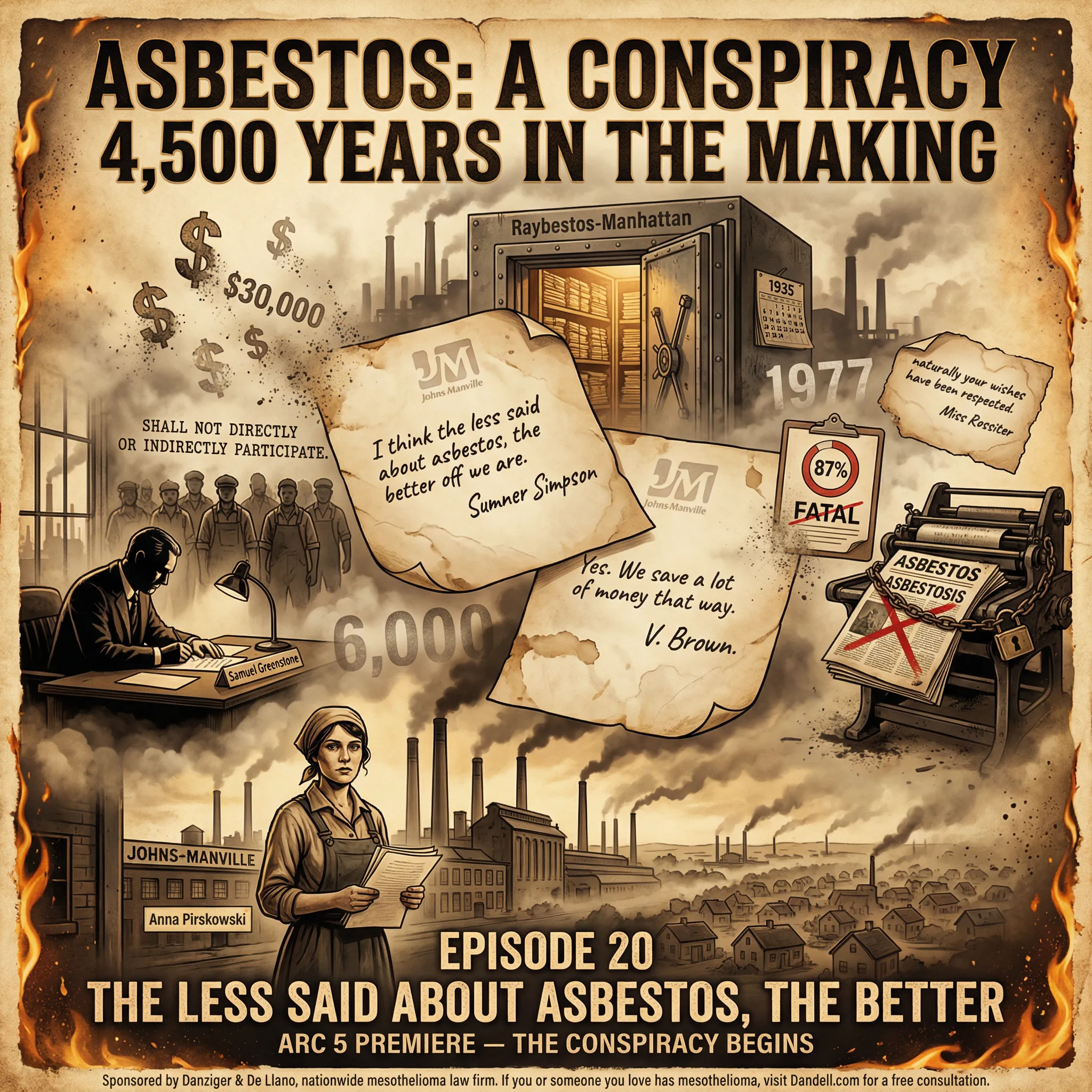
On October 1, 1935, Sumner Simpson—president of Raybestos-Manhattan, the second-largest asbestos manufacturer in America—sat at his desk in Bridgeport, Connecticut and wrote a letter to Vandiver Brown, the general counsel at Johns-Manville, the largest. Competitors, writing to each other about a problem they shared: asbestosis. A trade magazine editor in Philadelphia had been asking questions for years, wanting to publish something about the disease. Simpson's advice to Brown: "I think the less said about asbestos, the better off we are."
Those seven words would appear in thousands of lawsuits. They would cost the asbestos industry billions of dollars. And they survived because Simpson kept copies of his correspondence in a locked vault—copies that wouldn't be discovered until 1977, forty-two years later. When attorneys finally opened that vault, they found approximately 6,000 documents. Not a single damning letter, but a pattern: executive correspondence, research contracts with suppression clauses, settlement agreements with gag orders, and coordinated strategies between competitors to hide the truth about asbestos disease.
But the Simpson letter wasn't the beginning of the conspiracy. The beginning was 1929, when a woman named Anna Pirskowski walked into a Newark law office and filed the first asbestos personal injury lawsuit in American history.
Key Takeaways
- The first American asbestos lawsuit established a suppression template — In 1929, Anna Pirskowski and 10 other workers sued Johns-Manville. They split a $30,000 settlement ($2,727 each, about $68,000 in 2025 dollars), while their attorney was permanently banned from asbestos litigation.
- Competitors coordinated suppression strategy — Sumner Simpson (Raybestos-Manhattan) and Vandiver Brown (Johns-Manville) exchanged letters agreeing that "asbestosis receive the minimum of publicity."
- Scientific research was edited before publication — Dr. Anthony Lanza's 1935 study showing 87% fibrosis in long-term workers had the sentence "It is possible for uncomplicated asbestosis to result fatally" removed at industry request.
- Trade press complied with censorship — The editor of Asbestos magazine agreed to "publish nothing" about asbestosis, writing that Simpson's "wishes have been respected."
- "We save a lot of money that way" — When asked if Johns-Manville would "let them work until they dropped dead," executive Vandiver Brown replied: "Yes. We save a lot of money that way."
- 6,000 documents survived 42 years to prove conspiracy — The Sumner Simpson Papers, discovered in 1977 in a company vault, became the foundation for billions in asbestos litigation.
The First American Asbestos Lawsuit
In 1929, Anna Pirskowski—a former worker at the Johns-Manville plant in Manville, New Jersey—filed the first asbestos personal injury lawsuit in American history. The town itself was named after the company. Johns-Manville moved there in 1912, built a 186-acre facility, and at its peak employed 4,500 workers—forty percent of the town's workforce. A company town. Pirskowski worked there until 1922, when lung disease forced her out. Her surname suggests Polish or Eastern European heritage, consistent with the immigrant workforce at Manville. Almost nothing else survives about her in accessible archives.
Eventually eleven plaintiffs joined the lawsuit. We don't have their names—not in any publicly accessible record. They sued one of the largest corporations in America, and history didn't bother to write down who they were. The lawsuit dragged on for four years until Johns-Manville's Executive Committee authorized settlement negotiations—not just for this case, but creating "a system, a protocol for future settlements."
The settlement: $30,000, split eleven ways. About $2,727 per plaintiff. Roughly two years' factory wages. For a lung disease that was going to kill them.
Per plaintiff — what 11 dying workers received from Johns-Manville in 1933 ($68,000 in 2025 dollars)
The Silencing of Samuel Greenstone
Samuel Greenstone was the Newark attorney who represented all eleven plaintiffs. In exchange for the $30,000 settlement, he agreed that he would not "directly or indirectly participate in the bringing of new actions against the Corporation." He couldn't take another asbestos case against Johns-Manville. He couldn't refer cases. He couldn't consult. He couldn't advise. For the rest of his career.
After 1933, Samuel Greenstone vanishes from the historical record. No newspaper mentions. No bar records. No obituary has been found. The man who brought the first American asbestos lawsuit disappears.
Suppressing the Science and the Press
In Philadelphia, a woman known only as "Miss Rossiter" edited a trade magazine called Asbestos—published since 1919 by Stover Publishing Company. On September 25, 1935, she wrote to Simpson: "Always you have requested that for certain obvious reasons we publish nothing, and, naturally your wishes have been respected." She was asking permission—to publish in a magazine called Asbestos, about asbestos disease. Simpson and Brown coordinated their response, praising her for suppressing the news.
Meanwhile, Dr. Anthony Lanza—Associate Medical Director of the Industrial Hygiene Division at Metropolitan Life Insurance Company—was completing a study of workers at five asbestos plants and mines. His findings: 43% of workers with five years' exposure showed fibrosis. 58% with ten to fifteen years. And for workers with more than fifteen years of exposure: 87%. Court documents confirm that Brown and attorney George S. Hobart "suggested to Dr. Anthony Lanza that Lanza publish his study on textile workers with material alterations that would minimize the disease process and its seriousness." The sentence they removed: "It is possible for uncomplicated asbestosis to result fatally."
Why This Matters If You Were Exposed
The documents uncovered in this episode prove that by the early 1930s, the American asbestos industry knew its products were killing workers and chose to suppress that knowledge. The Sumner Simpson Papers—6,000 documents hidden for 42 years—established that this wasn't ignorance or negligence. It was policy. When Charles Roemer asked Johns-Manville executive Vandiver Brown if he would "let them work until they dropped dead," Brown replied: "Yes. We save a lot of money that way."
The latency period for mesothelioma is 20-50 years from first exposure. Someone exposed in the 1960s or 1970s at a Johns-Manville facility, a shipyard, a construction site, or an automotive shop may be diagnosed today. The corporate knowledge documented in these letters and memos—knowledge that companies deliberately concealed—is the foundation for mesothelioma claims. Over $30 billion remains available in asbestos trust funds specifically because companies like Johns-Manville and Raybestos-Manhattan knew the danger and proceeded anyway.
Available in asbestos trust funds for victims of occupational and secondary exposure
The Timeline: From Lawsuit to Cover-Up
| Year | What Happened | Significance |
|---|---|---|
| 1912 | Johns-Manville moves to Manville, NJ; builds 186-acre facility | Creates company town employing 4,500 workers — 40% of local workforce |
| 1929 | Anna Pirskowski files first American asbestos personal injury lawsuit | First lawsuit alleging failure to provide safe work environment with ventilation or protective masks |
| 1933 | 11 plaintiffs settle for $30,000; attorney Samuel Greenstone gagged | Settlement template established — pay minimal damages, silence the attorney, prevent future cases |
| 1930–1935 | Dr. Lanza studies workers at five asbestos plants; finds 43–87% fibrosis rates | Scientific proof of dose-response relationship between asbestos exposure duration and lung fibrosis |
| 1935 | Industry requests "material alterations" to Lanza study; fatal sentence deleted | Corporate editing of independent science — "It is possible for uncomplicated asbestosis to result fatally" removed |
| Sept 25, 1935 | Miss Rossiter writes to Simpson: "naturally your wishes have been respected" | Trade press censorship confirmed — Asbestos magazine suppressed disease reporting for years |
| Oct 1, 1935 | Simpson writes: "the less said about asbestos, the better off we are" | The defining document — competitors coordinating suppression strategy in writing |
| Early 1940s | Vandiver Brown asked if he'd "let them work until they dropped dead" — "Yes" | Direct admission of policy to prioritize profit over workers' lives |
| 1953 | Sumner Simpson dies; papers remain in locked vault | 6,000 documents survive because Simpson kept personal copies of corporate correspondence |
| 1977 | Sumner Simpson Papers discovered during litigation — 42 years after key letters | Judge finds evidence of "a conscious effort by the industry in the 1930s to downplay, or arguably suppress" information |
| 1930–1950 | US asbestos production increases 440% | While suppressing evidence of harm, industry expanded production dramatically |
Arc 5 Premiere: The Conspiracy Begins
Episode 20 launches Arc 5, "The Conspiracy Begins." Arc 4 asked "They knew—what did they do about it?" and the answer was mostly British: Merewether, Kershaw, Turner Brothers in Rochdale. Now we're crossing the Atlantic. While the British were writing reports and holding inquests, American executives were writing letters to each other—and they kept copies. Memos. Letters. Board meeting minutes. Settlement agreements. Research contracts with suppression clauses. The paper trail that proves it wasn't ignorance—it was policy.
Next week, Episode 21 examines the Asbestos Textile Institute—how industry coordination moved from informal letter-writing between executives to institutional suppression through trade associations.
About This Podcast
Asbestos: A Conspiracy 4,500 Years in the Making is a 52-episode documentary podcast series produced by Danziger & De Llano, LLP. The series traces the complete history of asbestos — from 4700 BCE to the 2024 EPA ban — revealing how a substance known for millennia as the "Magic Mineral" became one of history's deadliest industrial cover-ups.
Each episode combines archival research, historical analysis, and modern medical and legal context to document how corporations suppressed evidence of asbestos danger while workers and families died. Over 30 years, Danziger & De Llano has recovered nearly $2 billion for families affected by asbestos exposure. If you or a family member was exposed to asbestos and have questions about mesothelioma, compensation, or your legal rights, visit dandell.com for a free consultation.
The Asbestos Podcast is part of the MESO podcast network, dedicated to education and advocacy for mesothelioma victims and their families.
The complete episode transcript with citations, key facts, and additional context is available on WikiMesothelioma.com — our open educational resource for asbestos and mesothelioma information.
Meet the Team Behind This Episode
Senior Client Advocate, Danziger & De Llano
Senior Client Advocate whose father died of mesothelioma after working at the Shell refinery in Pasadena, Texas. Currently fighting his own battle with cancer while helping other families.

Founding Partner, Danziger & De Llano
Founding Partner at Danziger & De Llano with over 30 years of mesothelioma litigation experience. Co-executive producer of Puncture (2011).
Related Resources
Topics
Were You or a Loved One Exposed to Asbestos?
The history in this episode isn't just history. If you worked with asbestos products, lived in a home built with asbestos materials, or were exposed through a family member's work clothes, you may have legal options. Danziger & De Llano has spent 30+ years and recovered nearly $2 billion for asbestos victims.