What This Episode Covers
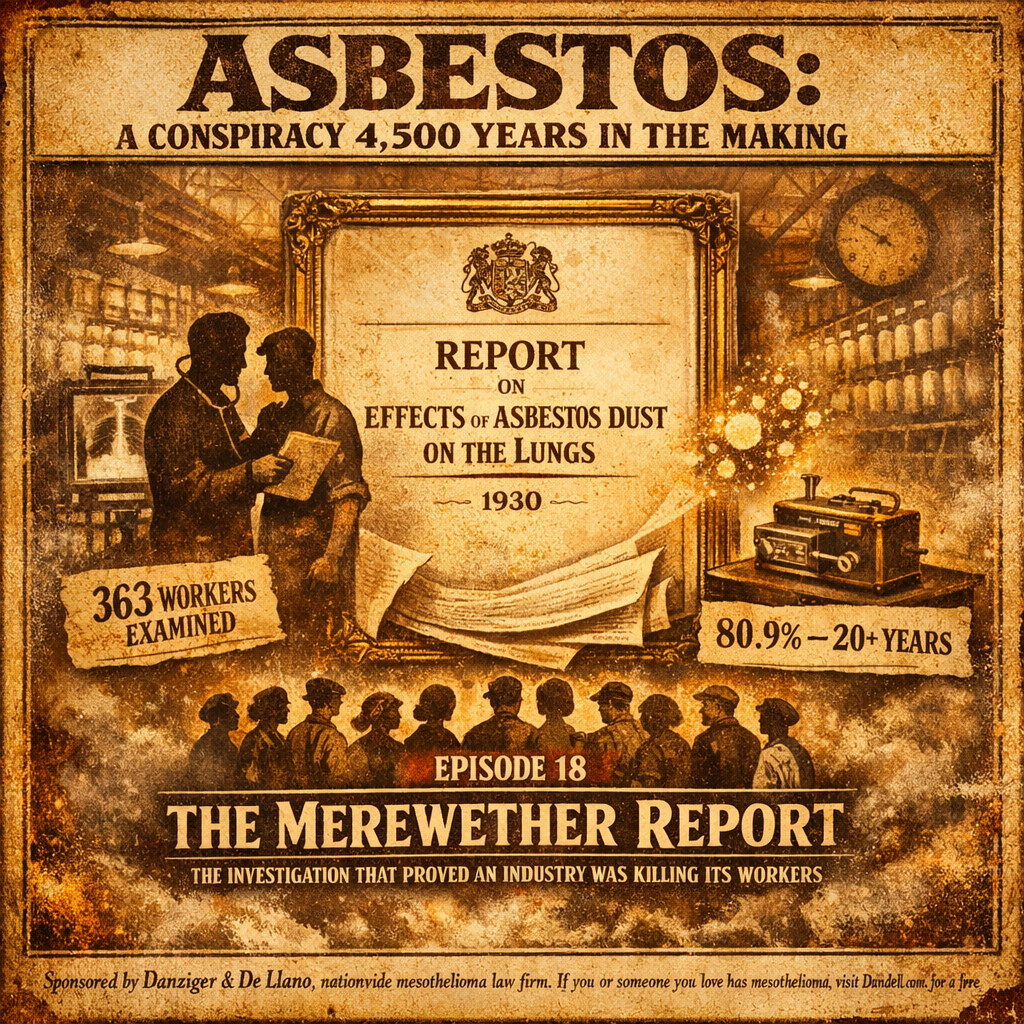
In 1928, the British government sent Dr. Edward Merewether into the Lancashire textile factories of Turner Brothers Asbestos. The dust was so thick that workers couldn't see across the room to read a wall clock. Merewether, a distinguished medical inspector trained in both law and medicine, conducted the first systematic investigation of asbestos disease. He examined 363 workers in textile mills and discovered something shocking: the longer workers breathed asbestos dust, the more likely they were to develop asbestosis. His data was undeniable. His recommendations were practical. But the industry's response would shape the next 80 years of death and deception.
The Merewether-Price Report, published in 1930, documented a dose-response cliff so steep it was unmistakable: after 20 years of exposure, 80.9% of workers had asbestosis. But this number carried a hidden horror — Merewether's sample deliberately excluded every worker too sick to report for examination, every widow whose husband had already died, every person too weak to stand in the clinic. The actual disease rate was far worse. Merewether predicted that his 12 specific engineering recommendations could produce "an almost total disappearance of the disease." The industry knew this. The government knew this. And they chose inaction that would cost hundreds of thousands of lives.
This episode reveals how one of history's most conclusive occupational health investigations became a roadmap that was deliberately ignored. It explains the survivorship bias that made Merewether's already shocking data an underestimate of the true toll. It traces the weak regulations that followed — regulations that covered textile workers but excluded insulators, the population with the highest exposure. And it shows how corporate knowledge of asbestos hazards, documented in 1930, became irrelevant to the companies that needed it most.
Key Takeaways
- 80.9% disease rate — Among workers with 20+ years asbestos exposure, nearly 4 in 5 had asbestosis, establishing an unmistakable dose-response relationship that was the first of its kind.
- Edward Merewether was a double-qualified expert — Both a licensed physician (with Gold Medal) and a lawyer trained at Gray's Inn, giving him medical credibility and legal precision in documenting findings.
- Survivorship bias made the data worse — The 363-worker sample excluded the sickest workers and those already dead, meaning the true disease rate was higher than even Merewether's alarming 80.9% figure.
- The dose-response cliff — After 15-19 years of exposure, disease rates jumped from 28.6% to 64.3%, then to 80.9% at 20+ years, creating unmistakable visual evidence of causation.
- 12 practical engineering controls were proposed — C.W. Price's co-authored recommendations included exhaust ventilation, enclosed machinery, wet dust suppression methods, and regular worker medical exams—all technically feasible and economically achievable.
- The industry chose regulations without teeth — Britain's 1931 Asbestos Industry Regulations covered only textile factories, excluded the largest exposure population (insulators), and resulted in just two prosecutions across 37 years.
Why This Matters If You Were Exposed
If you worked in a textile mill, insulation factory, shipyard, construction trade, or any industrial setting where asbestos was present before the 1970s, the Merewether Report proves that your employer's industry knew the risks decades before your exposure. This is not speculation. This is documented government science from 1930. It is the earliest systematic proof of asbestos danger in the historical record.
The latency period for mesothelioma is 20-50 years from first exposure. That means someone exposed in 1960 might not develop mesothelioma until 1980 or beyond. Someone exposed in 1975 might be diagnosed today. The Merewether Report's dose-response data — showing that 20+ years of exposure produced disease in 80.9% of workers — applies directly to you if your work history matches this timeline.
Approximately 3,000 Americans are diagnosed with mesothelioma each year, and over 30 billion dollars remains in asbestos trust funds set up by bankrupt companies to compensate victims. The Merewether Report is a cornerstone document in mesothelioma lawsuits because it proves corporate knowledge. Companies cannot claim they didn't know asbestos killed workers when the British government published that exact finding in 1930. If you or a family member was exposed, this documented knowledge timeline strengthens your claim.
Available in asbestos trust funds for victims of occupational exposure
The Timeline: From Investigation to Regulation
| Year | What Happened | Significance |
|---|---|---|
| 1892 | Edward Merewether born in Durham, England | Beginning of the career that would produce the first systematic occupational health investigation of asbestos |
| 1921 | Owens Jet Dust Counter invented (measurement standard) | Enabled precise quantification of airborne dust concentrations at worker breathing height |
| 1926 | Merewether called to the Bar (licensed as a lawyer) | Gained legal training that would add precision to his medical documentation and testimony |
| February 1928 | Seiler's case of pure asbestosis referred to Merewether; investigation commissioned | British government requested systematic investigation of asbestos disease prevalence in factories |
| 1928–1929 | Merewether & Price examine 363 textile workers in Turner Brothers & other mills | First large-scale occupational health survey documenting dose-response relationship |
| 1930 | Merewether-Price Report published & presented to Parliament | Documented 80.9% asbestosis rate in 20+ year exposures; recommended 12 engineering controls |
| 1931 | Asbestos Industry Regulations enacted (first asbestos workplace rules in the world) | Covered only textile factories; excluded insulators & other high-exposure occupations; weak enforcement |
| 1933–1934 | Merewether follow-up studies (mean latency 15.2 years to fatal exposure outcomes) | Confirmed dose-response relationship & documented rapid progression once symptoms began |
About This Podcast
This episode is part of "Asbestos: A Conspiracy 4,500 Years in the Making," a 52-episode documentary series chronicling the history of asbestos from ancient times to its ongoing human toll. Each episode reveals how a product known for millennia as the "Magic Mineral" became one of history's deadliest industrial cover-ups.
Produced by Danziger & De Llano, one of the nation's leading mesothelioma law firms, this podcast combines archival research, expert testimony, and legal analysis to show how corporate knowledge of asbestos danger was documented, suppressed, and deliberately ignored across decades and continents. If you were exposed to asbestos and have questions about your rights, compensation, or health monitoring, visit dandell.com for a free consultation.
The Asbestos Podcast is part of the MESO podcast network, dedicated to education and advocacy for mesothelioma victims and their families.
The complete episode transcript with citations, key facts, and additional context is available on WikiMesothelioma.com — our open educational resource for asbestos and mesothelioma information.
Meet the Team Behind This Episode

Founding Partner, Danziger & De Llano
30+ years of mesothelioma litigation. Northwestern University School of Law. Former CPA bringing financial expertise to asbestos trust fund claims.

Senior Patient Advocate
Specializes in occupational exposure cases including industrial trades, construction, and factory workers.
Related Resources
Topics
Were You or a Loved One Exposed to Asbestos?
The history in this episode isn't just history. If you worked with asbestos products, lived in a home built with asbestos materials, or were exposed through a family member's work clothes, you may have legal options. Danziger & De Llano has spent 30+ years and recovered nearly $2 billion for asbestos victims.