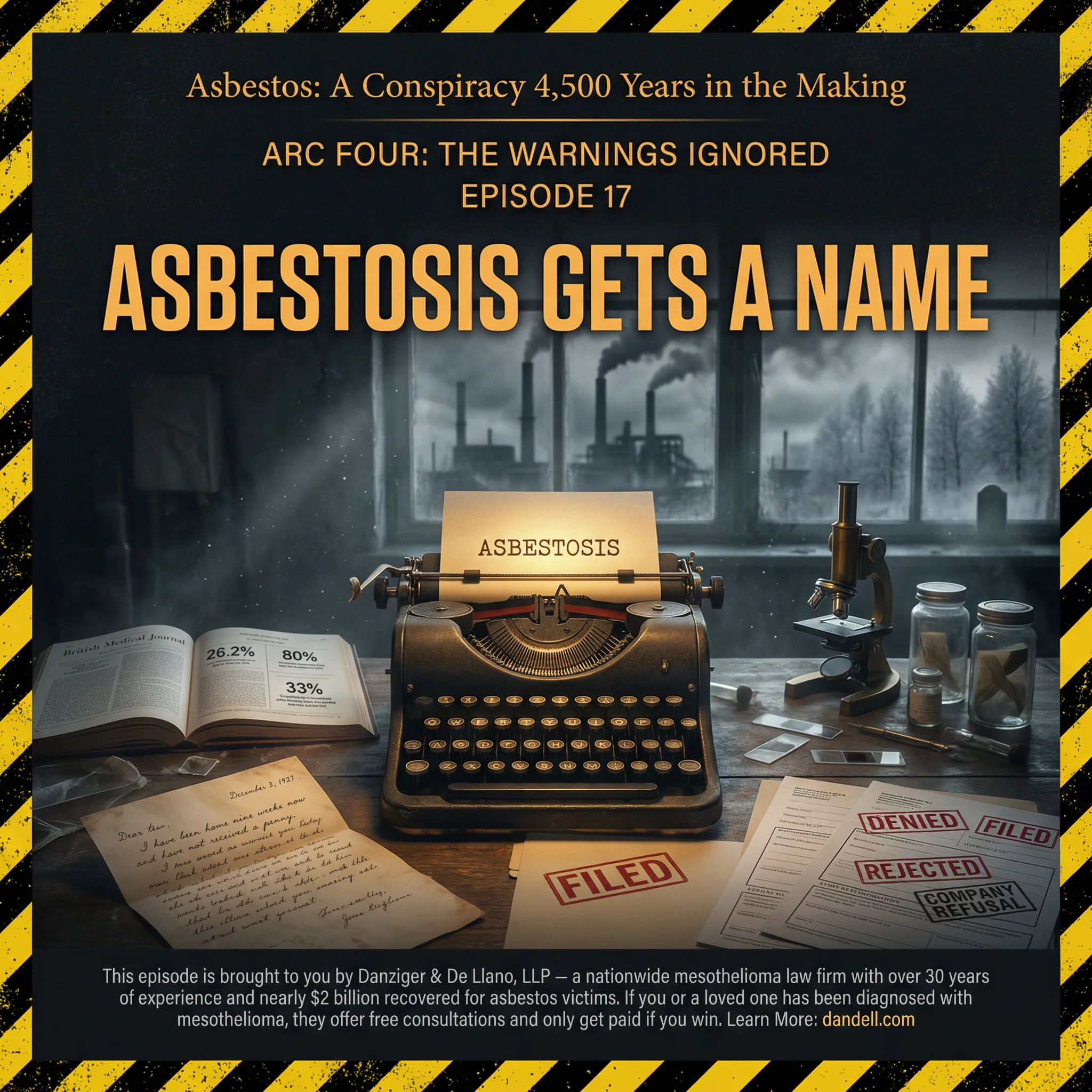
What This Episode Covers
Rochdale, 1924. Nellie Kershaw is buried in an unmarked grave. Three systems refuse her family: the coroner won't list asbestos on the death certificate because the disease doesn't yet have a legal name. The compensation board rejects her husband's claim for the same reason. And Turner Brothers Asbestos won't pay seven pounds for her funeral — it would set a precedent. You can't mourn a disease that doesn't exist. You can't compensate a family for a cause of death nobody will write down. This episode traces the next three years as that changes.
In 1927, three independent researchers converged on the same disease at the British Medical Association's annual meeting in Edinburgh. Published on consecutive pages of the British Medical Journal on December 3, 1927: the term "pulmonary asbestosis." Dr. William Edmund Cooke, a pathologist with a hobby in geology, recognized the mineral particles in Nellie's lungs. His geological expertise — his polarizing microscope, his fossil-hunting background — gave him what other pathologists missed. By 1930, the government investigation was complete: among British workers with 20+ years of exposure, 80.9% had asbestosis. The disease had a name. The numbers were undeniable. Published. Presented to Parliament.
And then the story crossed the Atlantic. Dr. Anthony J. Lanza's 1932 study for Johns-Manville found even worse numbers: 87% of textile workers with 15+ years of exposure showed fibrosis on X-ray. But Johns-Manville controlled whether it would be published. In 1934, their lawyers marked up the galley proofs. One sentence was deleted. Eight words: "It is possible for uncomplicated asbestosis to result fatally." By October 1935, the presidents of the two largest American asbestos companies had exchanged letters establishing a formal policy: the less said about asbestos, the better off we are.
Key Takeaways
- The disease was named in 1927 — Dr. William Edmund Cooke's geological training enabled him to identify asbestos fibers that other pathologists would have missed. Three independent researchers published "pulmonary asbestosis" on consecutive pages of the BMJ.
- 80.9% of long-term British workers had asbestosis — The Merewether-Price investigation examined 363 workers across British factories. Among those with 20+ years of exposure, 17 out of 21 workers (80.9%) had the disease.
- American industry suppressed even worse evidence — Dr. Lanza's study for Johns-Manville found 87% fibrosis among textile workers with 15+ years of exposure. The study was marked confidential from the start.
- Eight words were deleted from a public health report — "It is possible for uncomplicated asbestosis to result fatally" was removed from the published version of Lanza's study at the request of Johns-Manville's lawyers in 1934.
- Documented knowledge became coordinated suppression — By October 1935, the presidents of Raybestos-Manhattan and Johns-Manville had exchanged letters establishing a formal policy: "the less said about asbestos, the better off we are."
- $30+ billion in asbestos trust funds — remains available today for workers and families whose exposures occurred during this era of documented-but-suppressed evidence.
Why This Matters If You Were Exposed
Between 1927 and 1935, the asbestos industry went from passive negligence to active conspiracy. The disease was named. The numbers were published. The government confirmed it. And the American industry's response was to suppress the evidence, delete the fatal sentence, and establish a policy of silence that lasted four decades.
That documented knowledge and deliberate suppression is critical evidence in modern mesothelioma cases. If you or a family member worked in textiles, insulation, construction, shipbuilding, or manufacturing before 1980 — particularly if you worked with Johns-Manville, Raybestos-Manhattan, Turner & Newall, or other major manufacturers — your exposure occurred during this era of known hazards that were deliberately concealed. Mesothelioma has a 20-50 year latency period. Approximately 3,000 Americans are diagnosed each year. Over $30 billion remains available in asbestos trust funds to compensate victims and families.
Available in asbestos trust funds for victims of exposure occurring during the era of known hazards and deliberate suppression
The Timeline: Naming the Disease to Suppressing It (1927–1935)
| Year | Who | What They Found | Significance |
|---|---|---|---|
| 1927 | Cooke, McDonald, Oliver (BMA Edinburgh) | Three researchers published "pulmonary asbestosis" on consecutive pages of BMJ | Disease officially named. Consensus established. The word existed. |
| 1928 | Walter Leadbetter inquest, J.W. Roberts factory | 34-year-old worker dies; jury verdict: asbestos caused his death | First court verdict naming asbestos as cause of death. |
| 1930 | Merewether & Price investigation | 363 British workers examined; 80.9% with 20+ years exposure had asbestosis | Government epidemiological proof. Published. Presented to Parliament. |
| 1932 | Dr. Anthony J. Lanza, MetLife for Johns-Manville | 1,140 Manville workers examined; 87% of textile workers with 15+ years showed fibrosis | Worse American numbers. Study marked confidential from the start. |
| 1934 | Johns-Manville lawyers review Lanza's galley proofs | Eight words deleted: "It is possible for uncomplicated asbestosis to result fatally" | Scientific suppression. Public health report altered by corporate counsel. |
| October 1, 1935 | Sumner Simpson (Raybestos-Manhattan) to Vandiver Brown (Johns-Manville) | "I think the less said about asbestos, the better off we are" | Formal coordination to suppress information. Policy established. |
| October 3, 1935 | Vandiver Brown's reply | "Our interests are best served by having asbestosis receive the minimum of publicity" | Two executives. Two letters. Agreement on silence for four decades. |
About This Podcast
Asbestos: A Conspiracy 4,500 Years in the Making is a 52-episode documentary podcast tracing the complete history of asbestos — from 4700 BCE Finnish pottery to the 2024 EPA ban. Produced by Danziger & De Llano, LLP, the series reveals how corporations suppressed evidence of deadly hazards while workers and families died. New episodes drop weekly.
Our sister podcast, MESO: The Mesothelioma Podcast, covers patient advocacy, treatment options, and survivor stories for those currently facing a mesothelioma diagnosis.
The complete episode transcript with citations, key facts, and additional context is available on WikiMesothelioma.com — our open educational resource for asbestos and mesothelioma information.
Meet the Team Behind This Episode

Founding Partner, Danziger & De Llano
Founding Partner at Danziger & De Llano, Princeton graduate with corporate defense background turned plaintiff's attorney.

Executive Director of Client Services
18+ years mesothelioma advocacy. Former pharmaceutical industry professional. Host of MESO Podcast.
Related Resources
Topics
Were You or a Loved One Exposed to Asbestos?
The history in this episode isn't just history. If you worked with asbestos products, lived in a home built with asbestos materials, or were exposed through a family member's work clothes, you may have legal options. Danziger & De Llano has spent 30+ years and recovered nearly $2 billion for asbestos victims.