What This Episode Covers
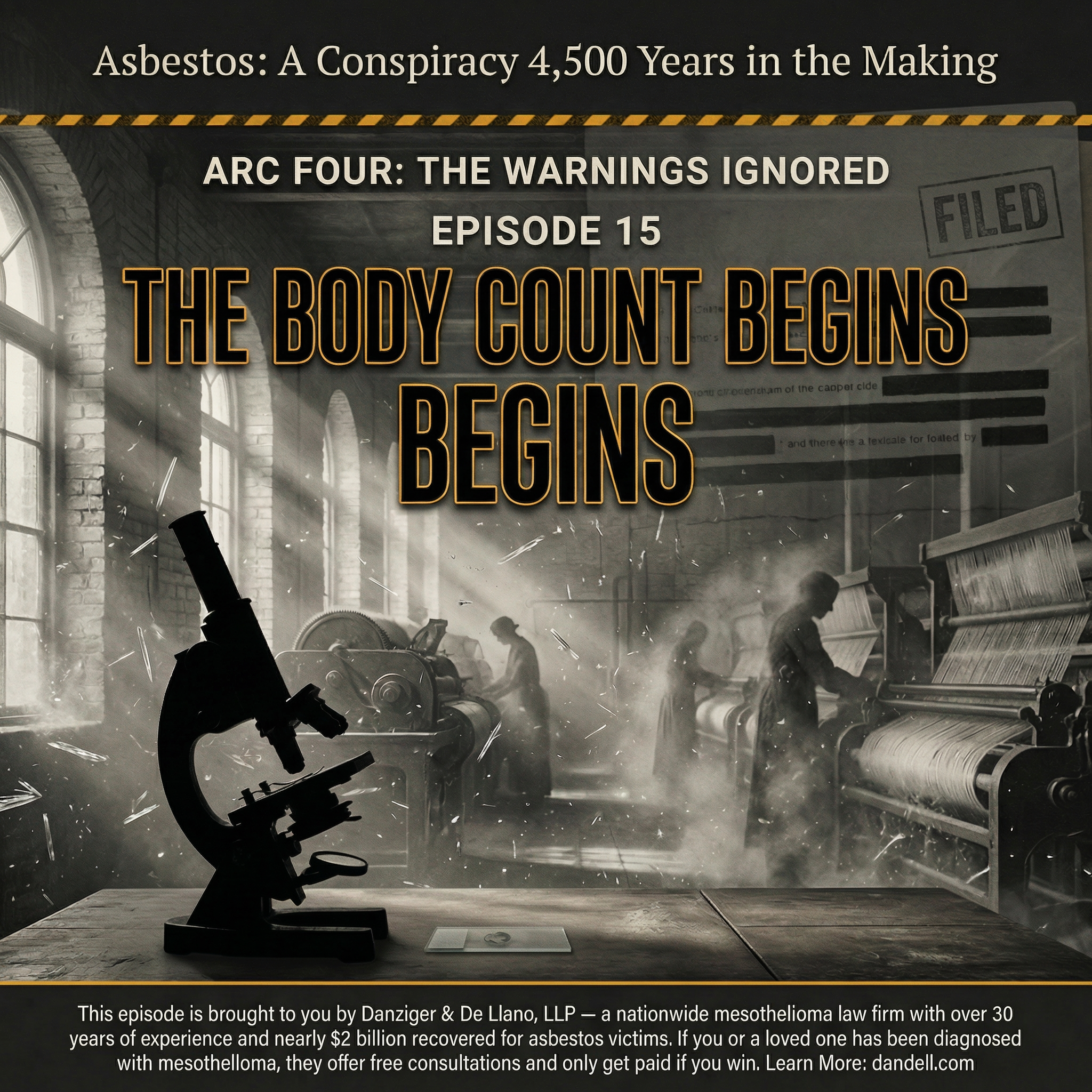
Eighteen ninety. A small town in Normandy, France. Paul Fleury recruits seventeen women from his cotton mill to card a different fiber. Same machines. Same motions. Same positions on the factory floor. The only thing different is the dust. Cotton dust settles. Asbestos dust doesn't. Sixteen of those seventeen workers are dead. Nobody investigates for sixteen years.
This episode opens Arc Four — The Warnings Ignored — by tracing the first documented evidence of asbestos danger across four countries between 1898 and 1914. Lucy Deane, one of Britain's first female factory inspectors, examines asbestos fibers under a microscope and identifies survivorship bias fifty years before epidemiologists name it. Thomas Legge, who looked through that same microscope, goes on to sit on the committee that excludes asbestos from worker compensation protections. Denis Auribault counts fifty dead in Normandy and files a report that becomes a "dead letter." Luigi Scarpa in Italy and Dr. Fahr in Germany each document the disease — and each misidentify the cause.
Six warnings. Four countries. Zero regulations. The system didn't need a conspiracy because it was already built to protect the industry. But that's about to change. By 1918, the evidence becomes impossible to ignore — and that's when the industry shifts from not caring to actively covering up.
Key Takeaways
- 16 of 17 workers dead — Paul Fleury's Normandy factory killed 94% of its original workforce. Denis Auribault documented 50 total deaths by 1906. His report was filed and forgotten for 91 years.
- Lucy Deane (1898) — One of Britain's first female factory inspectors examined asbestos fibers as "sharp, glass-like, jagged" and identified the survivorship bias mechanism that protected industry from liability. Her report was submitted to Parliament and ignored.
- Thomas Legge's 31-year silence — He looked through the microscope in 1898, heard testimony about ten dead workers in 1906, sat on the committee that excluded asbestos from the 1907 Workmen's Compensation Act, and didn't speak up until retirement — when he confessed to "opportunities for discovery and prevention badly missed."
- Four countries, zero action — Britain (1898), France (1906), Italy (1908), and Germany (1914) all had documented evidence of asbestos disease. Not one enacted regulations.
- The attribution trap — Auribault blamed calcium carbonate. Scarpa blamed tuberculosis. Fahr was "somewhat mystified." Doctors kept identifying the disease and misidentifying the killer.
- $30+ billion in trust funds — exists today to compensate workers and families whose exposures were never documented, including descendants of the very workers described in this episode.
Why This Matters If You Were Exposed
The workers in this episode were invisible by design. Lucy Deane filed her warning in 1898. Thomas Legge had the evidence and chose not to act. The 1907 Workmen's Compensation Act deliberately excluded asbestos while covering six other industrial diseases. If your parent, grandparent, or spouse worked in textiles, mining, manufacturing, or construction before 1980, they were likely breathing the same fibers Deane saw under her microscope — fibers that four countries had already documented as deadly.
Mesothelioma has a 20-50 year latency period. People exposed in the 1960s and 1970s are still being diagnosed today. And over $30 billion in asbestos trust funds exists specifically to compensate those workers and families — including those whose exposures were never officially counted. You don't need to prove which specific product caused the exposure. The trust fund system was designed to cover exactly the kind of undocumented exposures this episode describes.
Available in asbestos trust funds for victims of exposure — including workers whose hazards were deliberately undocumented
The Timeline: Six Warnings, Four Countries, Zero Regulations
| Year | What Happened | Regulatory Response |
|---|---|---|
| 1890 | Paul Fleury opens asbestos factory in Normandy; recruits 17 women from cotton mill | None — factory uninspected |
| 1898 | Lucy Deane & Thomas Legge examine asbestos fibers under microscope; Deane identifies survivorship bias | Report submitted to Parliament; filed |
| 1902 | Adelaide Anderson classifies asbestos as hazardous in "Dangerous Trades" | None |
| 1906 | Auribault documents 50 deaths in Normandy; Dr. Murray testifies about 10 dead workers in carding room | Report becomes "dead letter"; testimony ignored |
| 1907 | Workmen's Compensation Act updated: covers lead, mercury, arsenic, phosphorus, anthrax, hookworm | Asbestos deliberately excluded |
| 1908 | Luigi Scarpa (Italy) documents lung disease in 30 asbestos workers; misattributes to tuberculosis | None |
| 1914 | Dr. Fahr (Germany) publishes first fatal asbestosis case in medical journal | None |
| 1929 | Thomas Legge publishes Fourth Axiom: "All workmen should be told" — 31 years after seeing the fibers | Retirement confession only |
| 1934 | Legge's Industrial Maladies: "opportunities for discovery and prevention badly missed" | Retrospective admission |
| 1997 | France bans asbestos — 91 years after Auribault's report; Normandy valley known as "la vallée de la mort" | Ban enacted |
About This Podcast
Asbestos: A Conspiracy 4,500 Years in the Making is a 52-episode documentary podcast tracing the complete history of asbestos — from 4700 BCE Finnish pottery to the 2024 EPA ban. Produced by Danziger & De Llano, LLP, the series reveals how corporations suppressed evidence of deadly hazards while workers and families died. New episodes drop weekly.
Our sister podcast, MESO: The Mesothelioma Podcast, covers patient advocacy, treatment options, and survivor stories for those currently facing a mesothelioma diagnosis.
The complete episode transcript with citations, key facts, and additional context is available on WikiMesothelioma.com — our open educational resource for asbestos and mesothelioma information.
Meet the Team Behind This Episode

Director of Patient Support
Director of Patient Support with personal caregiver experience. Guides families through secondary exposure concerns.

Founding Partner, Danziger & De Llano
30+ years of mesothelioma litigation. Former CPA bringing financial expertise to asbestos trust fund claims.
Related Resources
Topics
Were You or a Loved One Exposed to Asbestos?
The history in this episode isn't just history. If you worked with asbestos products, lived in a home built with asbestos materials, or were exposed through a family member's work clothes, you may have legal options. Danziger & De Llano has spent 30+ years and recovered nearly $2 billion for asbestos victims.