What This Episode Covers
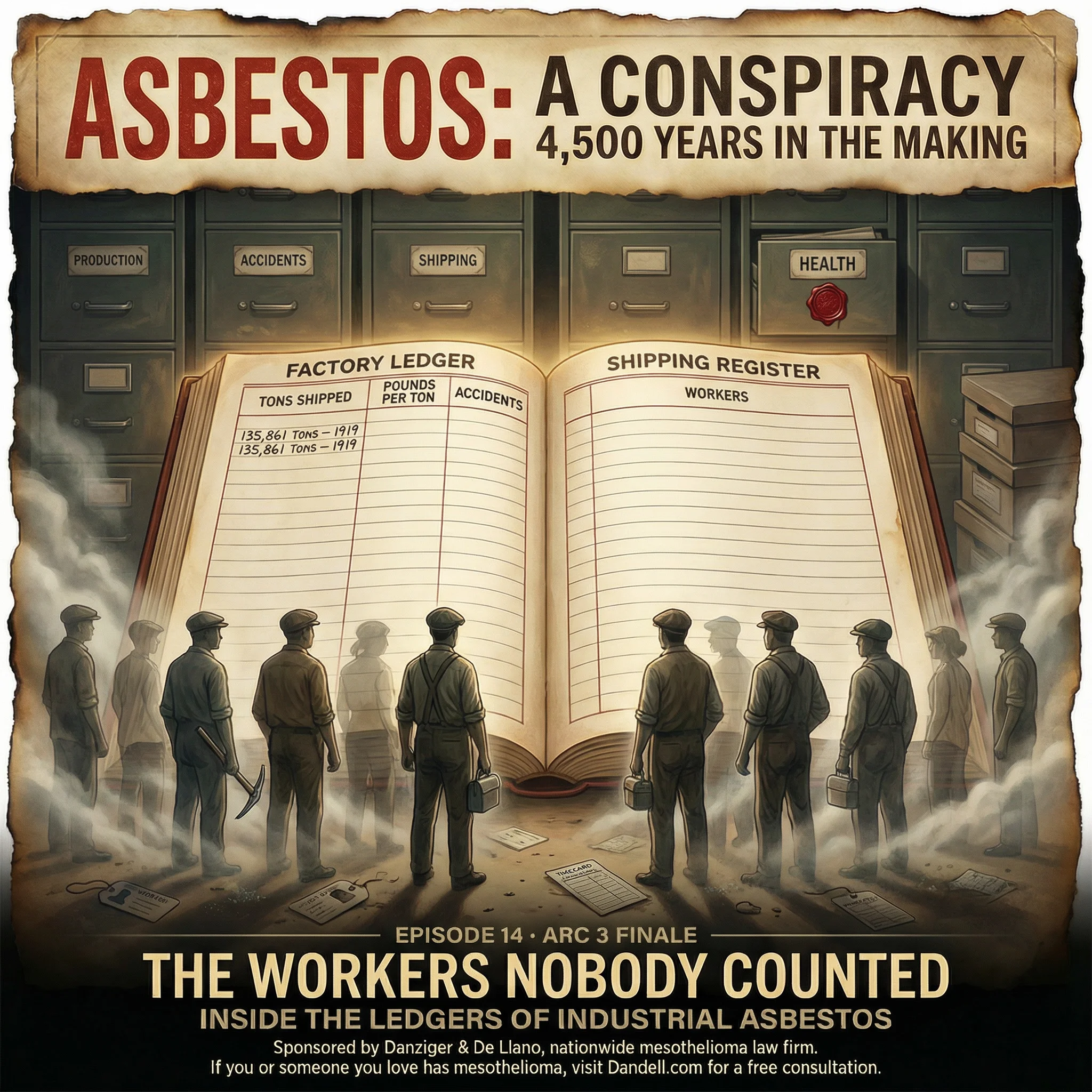
Nineteen nineteen. Quebec Bureau of Mines publishes its annual report with meticulous precision: 135,861 tons of asbestos shipped. Recovery rate: 100.8 pounds of fiber per ton of rock. They measured that to the tenth of a pound. Total employment: 8,930 workers. Man-years worked: 7,161. Wages paid: 7.3 million dollars. Twelve fatal accidents. Each documented with a name, an age, a cause of death. Now guess how many deaths from lung disease they recorded: zero.
This episode reveals how asbestos companies didn't conceal the truth — they engineered the system so truth wouldn't exist in the first place. Quebec Article 2163 required mining companies to report fatal accidents but had no requirement to track occupational disease. This wasn't oversight. It was architecture. The conspiracy doesn't start with what they knew. It starts with who they didn't bother to count.
From the cobbing room girls of Quebec photographed in floral prints for marketing brochures (while their health was never tracked) to Dr. H. Montague Murray's patient in London claiming nine coworkers dead (none of whom were ever investigated), to Nellie Kershaw — who worked in asbestos mills from age 12 to 33 and died of asbestosis while the company denied it existed — this episode documents the workers who fell through the void in the paperwork.
Key Takeaways
- 135,861 tons of asbestos shipped by Quebec in 1919 with measurements precise to the tenth of a pound. Zero disease deaths recorded despite 8,930 workers employed.
- The structural void: Quebec Article 2163 made accident documentation mandatory; disease surveillance was optional. This legal gap created plausible deniability by design.
- Nellie Kershaw — age 12 to 33 at Turner Brothers Asbestos. Developed asbestosis. Company denied it. Died March 14, 1924. Grave went unmarked. First official British asbestosis death.
- The missing nine: Dr. Murray's dying patient claimed nine coworkers dead in 1899. No investigation. Names never found. Over 120 years later, they remain unidentified.
- Coal mining comparison: Britain documented 164,000+ mining deaths by name (1850-1920). Quebec asbestos mines recorded zero disease deaths despite identical workplace mortality rates (1.67 per thousand workers).
- Insurance industry secrecy: By 1918, Prudential Insurance had data proving asbestos hazard and was already declining worker coverage. Workers and public were kept uninformed. Two sets of books.
Why This Matters If You Were Exposed
The workers described in this episode were invisible by design. If your parent, grandparent, or relative worked in asbestos mining, manufacturing, textiles, or construction before 1980, they were likely exposed to fibers that companies already knew were deadly — but had systematically chosen not to document or disclose.
The injury comes in two layers: first the asbestos exposure itself, then the erasure — no record of your exposure, no documentation of your employer's knowledge, decades of invisibility while asbestos-related disease develops silently. But mesothelioma has a 20-50 year latency period. People exposed in the 1960s and 1970s are still being diagnosed today. And over $30 billion in asbestos trust funds exists specifically to compensate those workers and families — including those whose exposures were never officially counted.
Available in asbestos trust funds for victims of exposure — including workers whose hazards were deliberately undocumented
The Timeline: From Silence to the First Named Death
| Year | What Happened | Who Knew |
|---|---|---|
| 1850 | Coal Mines Inspection Act (Britain): mandatory death reporting system established | British government |
| 1898 | Lucy Deane (UK factory inspector) observes asbestos fibers as "sharp glass-like jagged nature"; recommends protective measures | UK government |
| 1899 | Dr. Murray's patient (age 33, dying) claims nine coworkers already dead; no investigation initiated | Dr. Murray, no one else |
| 1906 | Denis Auribault (France) files inspection report documenting 50 worker deaths; workers remain unnamed | French government |
| 1918 | Prudential Insurance (Hoffman memo): insurer already declining asbestos worker coverage | Insurance industry; NOT workers or public |
| 1919 | Quebec Bureau of Mines annual report: 135,861 tons, zero disease deaths recorded | Mining industry, government |
| 1922 | Nellie Kershaw diagnosed with asbestos disease; applies for compensation | Turner Brothers denies causation |
| 1924 | Nellie Kershaw dies March 14, age 33; coroner's inquest rules asbestosis (first official use of term) | Public record established |
| 1929 | Metropolitan Life-Johns-Manville study: 87% of 15+ year workers have asbestosis; study suppressed for 4 years | Johns-Manville executives |
| 1931 | First UK asbestos regulations enacted — 33 years after Lucy Deane's warning | Finally, the public |
About This Podcast
Asbestos: A Conspiracy 4,500 Years in the Making is a 52-episode documentary podcast tracing the complete history of asbestos — from 4700 BCE Finnish pottery to the 2024 EPA ban. Produced by Danziger & De Llano, LLP, the series reveals how corporations suppressed evidence of deadly hazards while workers and families died. New episodes drop weekly.
Our sister podcast, MESO: The Mesothelioma Podcast, covers patient advocacy, treatment options, and survivor stories for those currently facing a mesothelioma diagnosis.
The complete episode transcript with citations, key facts, and additional context is available on WikiMesothelioma.com — our open educational resource for asbestos and mesothelioma information.
Meet the Team Behind This Episode

Executive Director of Client Services
18+ Years Mesothelioma Advocacy | 20 Years Pharmaceutical Industry | Host of MESO Podcast
Senior Advocate
Senior Advocate specializing in military and shipyard exposure cases. Veteran himself, fighting his own cancer diagnosis.
Related Resources
Topics
Were You or a Loved One Exposed to Asbestos?
The history in this episode isn't just history. If you worked with asbestos products, lived in a home built with asbestos materials, or were exposed through a family member's work clothes, you may have legal options. Danziger & De Llano has spent 30+ years and recovered nearly $2 billion for asbestos victims.