What This Episode Covers
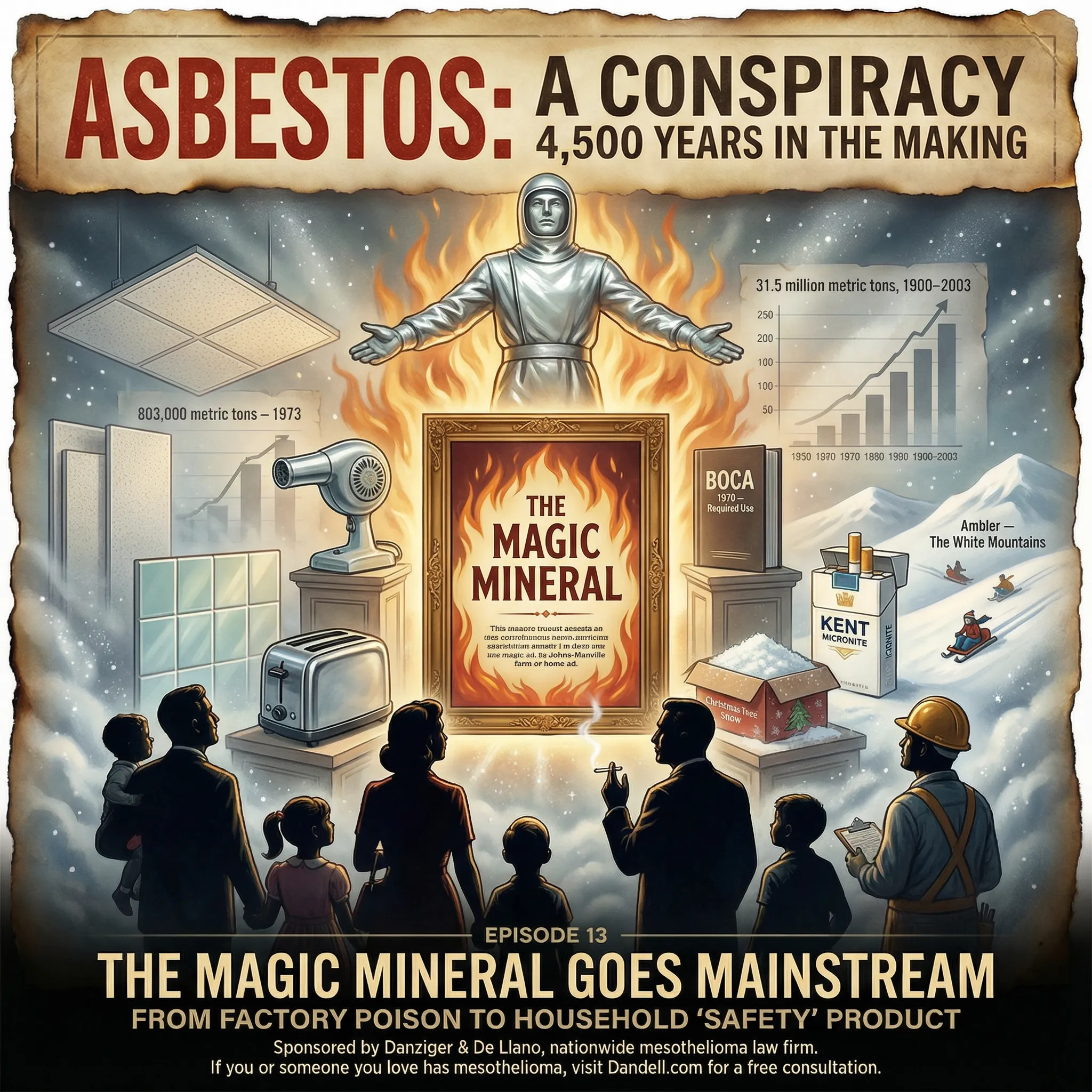
In 1918, Prudential Insurance refused to cover asbestos workers — they considered the risk too obvious to bet money on. Nineteen years later, Johns-Manville took out a full-page ad targeting American farmers: "Let this magic mineral, ASBESTOS, protect the buildings on your farm!"
That gap — between what the industry knew and what it told consumers — is the story of Episode 13. From the 1939 World's Fair where 30 million visitors saw asbestos celebrated as a miracle of modern living, to the 1950 Mrs. America campaign showing smiling housewives installing asbestos ceiling tiles with their bare hands, to the building codes that made asbestos not just available but legally required — this episode documents how a known poison became the most ubiquitous building material in American history.
By 1973, the United States consumed 803,000 metric tons of asbestos in a single year. Half of all asbestos ever used in this country was used after 1960, when the hazards were already documented in corporate files and insurance records. The people using these products — farmers, homeowners, veterans buying their first houses with VA loans — had no idea.
Key Takeaways
- 3,000+ consumer products contained asbestos by 1958, from building materials to hair dryers, oven mitts, and Christmas tree snow — all sold without safety warnings.
- Building codes required asbestos. The 1970 BOCA code specified asbestos for fire safety. Federal VA and FHA housing programs mandated it from the 1940s through the mid-1980s.
- Kent cigarette filters (1952-1956) contained blue crocidolite asbestos marketed as "healthier." A pack-a-day smoker inhaled 131 million asbestos fibers annually. 28 of 33 factory workers died.
- 803,000 metric tons consumed in 1973 alone — peak U.S. consumption, 55 years after insurers flagged the hazard.
- Ambler, Pennsylvania — children played on 1.5 million cubic yards of asbestos waste at the Keasbey & Mattison factory site. EPA Superfund cleanup took 31 years (1986-2017).
- Consumer exposure was never tracked. Unlike workers covered by OSHA, homeowners and families had no monitoring, no records, and no way to prove causation decades later when they got sick.
Why This Matters If You Were Exposed
The products described in this episode were everywhere. If your home was built or renovated between 1940 and 1980, it almost certainly contained asbestos — in the roofing, the floor tiles, the pipe insulation, possibly the popcorn ceiling texture. If you or a family member did renovation work, cut into old siding, or replaced ceiling tiles, you may have been exposed without knowing it.
The difficulty with consumer exposure is proving it decades later. The companies that marketed these products counted on exactly that — by the time people got sick, the connection to a specific product or home renovation would be invisible. But asbestos trust funds were established precisely for this reason. Over $30 billion is currently available for victims, and you don't need to prove which specific product caused your exposure to file a claim.
Available in asbestos trust funds for victims of exposure — including consumer and household exposure
The Timeline: From Knowledge to Peak Exposure
| Year | What Happened | What Consumers Were Told |
|---|---|---|
| 1918 | Prudential Insurance flags asbestos workers as uninsurable | Nothing |
| 1937 | Johns-Manville launches "magic mineral" consumer campaign | Asbestos is safe, modern, and essential |
| 1939 | 30 million people visit the Johns-Manville World's Fair pavilion | Asbestos is a miracle of modern science |
| 1950 | Mrs. America campaign: housewife DIY asbestos installation | Safe enough for your wife to install |
| 1952 | Kent puts crocidolite asbestos in cigarette filters | The "healthier" option |
| 1958 | USGS documents 3,000+ asbestos applications | Still no consumer warnings |
| 1973 | Peak: 803,000 metric tons consumed; EPA bans spray-applied asbestos | First restrictions begin — 55 years after insurance industry knew |
About This Podcast
Asbestos: A Conspiracy 4,500 Years in the Making is a 52-episode documentary podcast tracing the complete history of asbestos — from 4700 BCE Finnish pottery to the 2024 EPA ban. Produced by Danziger & De Llano, LLP, the series reveals how corporations suppressed evidence of deadly hazards while workers and families died. New episodes drop weekly.
Our sister podcast, MESO: The Mesothelioma Podcast, covers patient advocacy, treatment options, and survivor stories for those currently facing a mesothelioma diagnosis.
The complete episode transcript with citations, key facts, and additional context is available on WikiMesothelioma.com — our open educational resource for asbestos and mesothelioma information.
Meet the Team Behind This Episode

Founding Partner, Danziger & De Llano
30+ years of mesothelioma litigation. Former CPA bringing financial expertise to asbestos trust fund claims.

Director of Patient Support
Director of Patient Support with personal caregiver experience. Guides families through secondary exposure concerns.
Related Resources
Topics
Were You or a Loved One Exposed to Asbestos?
The history in this episode isn't just history. If you worked with asbestos products, lived in a home built with asbestos materials, or were exposed through a family member's work clothes, you may have legal options. Danziger & De Llano has spent 30+ years and recovered nearly $2 billion for asbestos victims.