What This Episode Covers
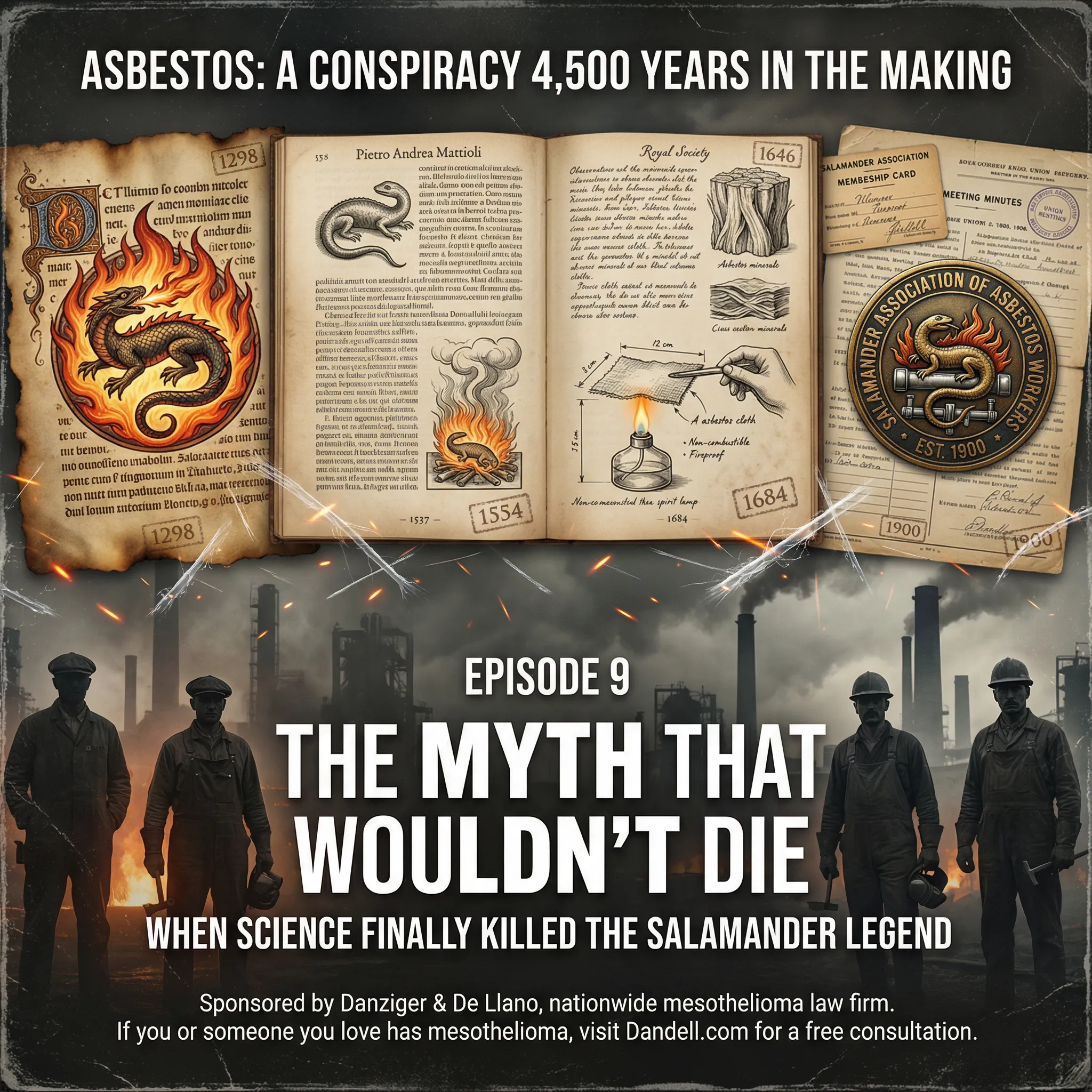
The salamander myth lasted 4,500 years. Not because it was true — it wasn't. But because belief persists differently than evidence does. In 1646, Thomas Browne published Pseudodoxia Epidemica ("Epidemic of False Beliefs") with a chapter called "Of the Salamander." He compiled Renaissance experiments: physicians had burned salamanders in fire and documented their immediate death. The myth was dead in institutional science. Yet three centuries later, American workers would name a union after it.
This episode traces how knowledge gets lost in translation, how institutions legitimize evidence through formal experiments, and how mythologies can be replaced without being eliminated. Pietro Andrea Mattioli's 1554 experimental report — "having made trial, we saw a salamander burnt in a short time by fire" — circulated in 32,000 copies. Yet Browne probably never saw it. What he found instead was Marco Polo's 1298 account describing asbestos mineral properties, with an explicit debunking of the salamander myth. But that debunking had been edited out of English translations. The citation chain goes: original 1298 manuscript → Frampton's abridged 1579 translation → Purchas's "unfaithful" 1625 compilation → Browne's 1646 access to only the technical content. Three hundred fifty years of knowledge systematically degraded through transmission.
The Royal Society made it official in 1684. They tested asbestos. They measured it. They published it. By 1728, encyclopedias normalized asbestos as a mineral and the salamander myth had completely disappeared from educated discourse. Victory, right? Not quite. The myth didn't disappear. It got replaced. One myth (magical creature immunity) exchanged for another (industrial product safety). And American asbestos workers — formed into the Salamander Association in 1903 with a salamander-surrounded-by-flames logo — named themselves after the very myth that had been replaced by a new mythology of safety.
The complete episode transcript with citations, key facts, and additional context is available on WikiMesothelioma.com — our open educational resource for asbestos and mesothelioma information.
Meet the Team Behind This Episode
Director of Patient Support
Director of Patient Support with personal caregiver experience. Guides families through secondary exposure concerns.
Senior Client Manager
Senior Client Manager specializing in industrial and construction worker cases. Expert in occupational exposure identification.
Related Resources
Topics
Were You or a Loved One Exposed to Asbestos?
The history in this episode isn't just history. If you worked with asbestos products, lived in a home built with asbestos materials, or were exposed through a family member's work clothes, you may have legal options. Danziger & De Llano has spent 30+ years and recovered nearly $2 billion for asbestos victims.