What This Episode Covers
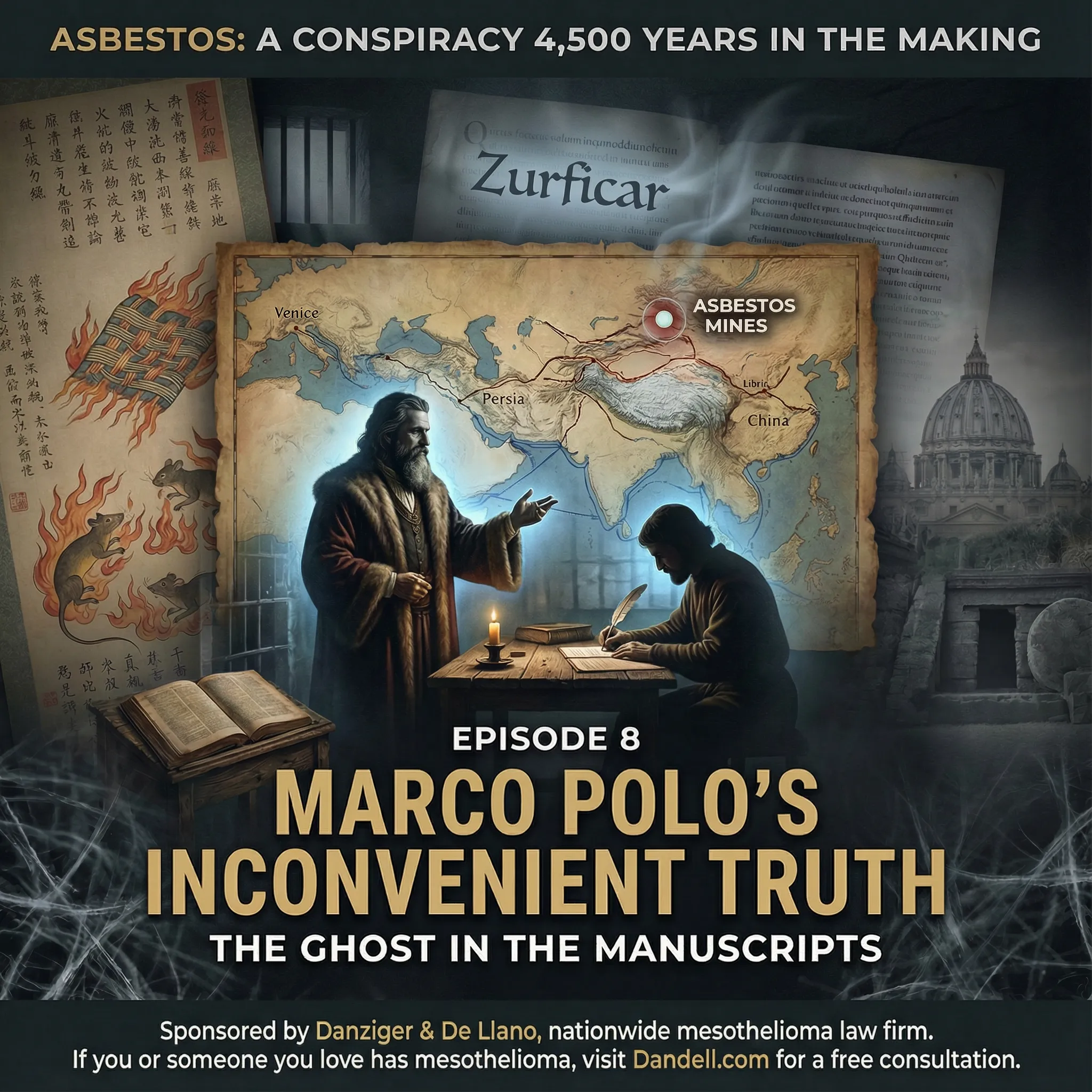
September 1298. The Genoese navy destroys the Venetian fleet at the Battle of Curzola. Marco Polo, merchant and adventurer, finds himself imprisoned alongside Rustichello da Pisa, a romance novelist who's been rotting in a cell for fourteen years. What follows is one of history's most consequential conversations: Marco dictates his memoirs, Rustichello writes them down, and asbestos—a material almost nobody documented—becomes the subject of the most detailed eyewitness account of medieval mining and processing ever recorded.
The episode examines a crucial paradox: Marco Polo's account is virtually unique not because it's unreliable, but because medieval institutions never bothered to document asbestos. Venetian merchants kept meticulous records of seventeen grades of wool and pepper prices in Constantinople. They recorded nothing about asbestos. Not because asbestos didn't exist—diplomatic gifts prove it did—but because materials that never entered commercial trade left no paper trail. No customs duty. No guild pricing. No merchant accounts. Asbestos existed in the gaps between the systems that create historical records.
The episode also traces how Marco Polo's technical accuracy regarding mining and fiber processing contrasts sharply with unreliable narrative claims about papal gifts. And it establishes the 350-year gap between Marco's 1298 debunking of the "fire salamander" myth and Thomas Browne's 1646 experimental confirmation—demonstrating how institutional authority can suppress eyewitness testimony until empirical verification overcomes textual tradition.
Key Takeaways
- Documentary invisibility paradox: Medieval asbestos was simultaneously absent from trade records (too rare to commercialize) and absent from fraud prosecution records (too rare to prosecute systematically). Materials can fall outside institutional capture not through deliberate suppression, but through rarity.
- Zurficar—a ghost source: Named in only one document (Marco Polo's Travels), appearing in 150 surviving manuscripts all traced to a single Genoese prison dictation. The name suggests eyewitness detail; the absence of independent verification illustrates how individuals can exist in only one documentary source.
- Technical accuracy, narrative unreliability: Marco Polo's descriptions of mining, crushing, washing, and fiber preparation match seventh-century Chinese sources exactly—verifying eyewitness observation. His claim that Kublai Khan sent an asbestos napkin to the Pope is fabricated; the Vatican cloth came from a Roman tomb centuries earlier.
- Independent mythologies, convergent technical knowledge: Europeans invented fire salamanders; Chinese invented fire mice (huǒ shǔ). Different cultures, identical myths. But both documented the same processing techniques: extraction → crushing → washing → fire-cleaning. Technical descriptions cross cultures and centuries; origin myths do not.
- The 350-year suppression of eyewitness: From 1298 to 1646, one merchant's firsthand account couldn't displace institutional scholarship. Medieval encyclopedias, monastery copies, university texts—all teaching that salamanders lived in fire. Only experimental verification—throwing a salamander in a fire and watching it die—could overcome 350 years of inherited doctrine.
- Documentary gaps and asbestos litigation: If medieval institutions couldn't document asbestos because it was too rare to capture, modern corporations learned the inverse: destroy documentation to create rarity. But paper trails, internal memos, and trade records do survive—and lawyers like those at Danziger & De Llano spend decades finding them.
Why This Matters If You Were Exposed
This episode teaches a critical lesson about documentation: absence of records doesn't mean absence of exposure. Medieval asbestos left no trade documentation because it never entered commercial markets. Modern asbestos does exactly the opposite—it saturates markets and building codes, yet companies systematically suppressed and destroyed health records. But unlike Marco Polo's ghost source Zurficar, there are paper trails. Internal memos. Insurance files. Court depositions. Occupational exposure databases. The companies counted on you becoming invisible in the archives decades later, unable to prove where you were exposed or to whom you should hold accountable. That invisibility is the lie they bet on.
Unlike consumers in medieval times, modern workers and families have legal remedies. Over thirty years of litigation has recovered internal industry documents proving that asbestos manufacturers knew the hazards and concealed them. Asbestos trust funds exist precisely to compensate people whose exposure is difficult to prove—because your lack of documentation is not your fault. It's the industry's deliberate strategy. The documentary evidence that does exist, recovered by mesothelioma attorneys, is sufficient to establish causation and liability in thousands of cases.
Of litigation uncovering suppressed industry documents proving knowledge of hazards and deliberate concealment
The Timeline: From Eyewitness to Experimental Proof
| Year | What Happened | Documentary Status |
|---|---|---|
| 237 C.E. | Wei Dynasty receives asbestos cloth as tribute; Emperor Cao Pi's essay claiming fire-proof cloth impossible is scraped from monument when cloth proves functional | Chinese: "fire-wash cloth" (huǒ huàn bù) documented |
| 1267 | Ahmad Fanakati (finance minister) proposes mineral fiber investment; Kublai Khan expands mining in Xinjiang | Government bureaucratization of asbestos production |
| 1295 | Marco Polo returns to Venice after 24-year journey to China | Eyewitness testimony preparation |
| September 1298 | Battle of Curzola: Marco Polo captured; imprisoned in Genoa; begins dictating memoirs to Rustichello da Pisa | Primary source: single prison conversation |
| 1298 | Marco Polo: "The Salamander is no beast"—debunks fire salamander myth; documents mining process in detail | Only named source: Zurficar (mining supervisor) |
| 1324 | Marco Polo dies in Venice | 150 surviving manuscripts, all traced to single source |
| 1559 | Giovanni Battista Ramusio attributes "Il Milione" mockery to contemporary sources—235 years after Marco's death (legend fabricated post-mortally) | Historical narrative constructed centuries after death |
| 1646 | Thomas Browne throws salamander into fire; documents mortality; experimentally refutes 350-year-old myth | Empirical verification displaces institutional authority |
About This Podcast
Asbestos: A Conspiracy 4,500 Years in the Making is a 52-episode documentary podcast tracing the complete history of asbestos — from 4700 BCE Finnish pottery to the 2024 EPA ban. Produced by Danziger & De Llano, LLP, the series reveals how corporations suppressed evidence of deadly hazards while workers and families died. New episodes drop weekly.
Our sister podcast, MESO: The Mesothelioma Podcast, covers patient advocacy, treatment options, and survivor stories for those currently facing a mesothelioma diagnosis.
The complete episode transcript with citations, key facts, and additional context is available on WikiMesothelioma.com — our open educational resource for asbestos and mesothelioma information.
Meet the Team Behind This Episode
Founding Partner, Danziger & De Llano
Princeton graduate with corporate defense background. Specializes in statute of limitations, evidence preservation, and corporate liability.

Founding Partner, Danziger & De Llano
30+ years of mesothelioma litigation. Former CPA bringing financial expertise to asbestos trust fund claims.
Related Resources
Topics
Were You or a Loved One Exposed to Asbestos?
The history in this episode isn't just history. If you worked with asbestos products, lived in a home built with asbestos materials, or were exposed through a family member's work clothes, you may have legal options. Danziger & De Llano has spent 30+ years and recovered nearly $2 billion for asbestos victims.