What This Episode Covers
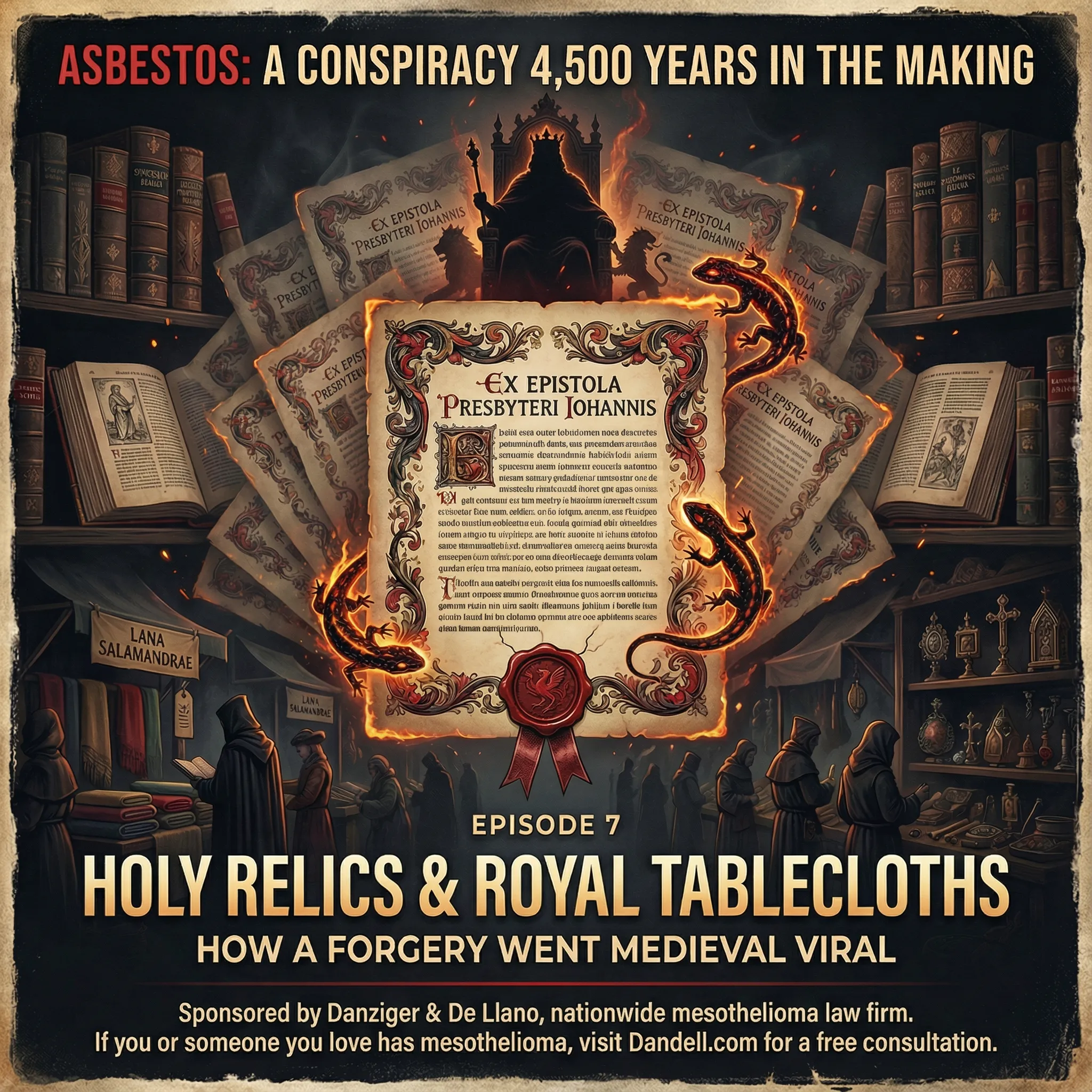
In 1145, a legend emerges. A powerful Christian king named Prester John rules somewhere beyond Persia, waiting to ally with European Crusaders against Islam. The legend is pure medieval wish fulfillment — a story everyone desperately wants to believe. But around 1165, someone writes a letter claiming to be from this legendary king. The letter is a forgery. And it includes a claim that will reshape European knowledge for the next 500 years: salamanders produce fireproof cloth.
This episode traces how a single forged document, copied 469 times across medieval Europe, beat institutional knowledge from the world's greatest libraries and the direct testimony of an eyewitness merchant. It documents the medieval con artists who sold asbestos cloth to monasteries as holy relics, proving authenticity with a simple fire test. It identifies the one medieval skeptic who saw through the scam — and why his skepticism lost to encyclopedic authority. And it exposes how modern myths about medieval history get laundered through citation chains until the original fabrication disappears.
The story is about authority, repetition, and the machinery that turns lies into truth. The same machinery that would later suppress asbestos hazards while 803,000 metric tons were consumed in a single year. Medieval history. Modern consequences.
Key Takeaways
- 469 manuscript copies of the Letter of Prester John survived — the most copied document in medieval Europe. A single forged letter invented the salamander-asbestos connection around 1165.
- Encyclopedic authority defeated skepticism. Albertus Magnus identified the fraud mechanism (merchants marketing asbestos as salamander wool) around 1250, but Vincent of Beauvais's royal-sponsored encyclopedia and Bartholomaeus Anglicus's widely-printed reference had institutional backing he lacked.
- The Church profited from the myth. Asbestos cloth sold as holy relics generated donations from pilgrims. The fire test (heating asbestos whitens it) appeared miraculous. The institution with the most to gain had no incentive to investigate.
- Augustine's doctrine legitimized the fraud. The Church taught that salamanders survive eternal fire, therefore damned souls survive damnation. Doubting the salamander myth meant theological heresy — regulatory capture through doctrine.
- Marco Polo watched them mine it. Around 1275, he observed asbestos mining in China and documented the truth: "The real truth is that the Salamander is no beast... but is a substance found in the earth." Eyewitness testimony. Completely ignored.
- The Charlemagne tablecloth story is fabricated. The famous myth of Emperor Charlemagne owning a fireproof asbestos tablecloth has zero medieval sources. It's an 18th-century invention that's now cited everywhere without anyone checking the original.
Why This Matters If You're Studying Corporate Deception
The medieval period shows the first documented version of how institutional authority beats truth. Encyclopedias, the Church, merchant networks, and theological doctrine all created a system that made the salamander myth more real than reality. Hundreds of manuscript copies. Royal sponsorship. Theological legitimacy. Economic incentives for every institution involved. A single skeptic couldn't survive that.
Fast-forward 700 years. The same patterns recur: corporations with financial incentives to suppress information, scientific literature hidden from public view, regulatory bodies influenced by the industries they oversee, and institutional authority (now backed by engineering societies and insurance trade groups rather than monks and encyclopedists) overwhelming individual testimony from workers dying of asbestos-related diseases.
The salamander-asbestos myth persisted from the Letter of Prester John (c. 1165) through the Renaissance and beyond — despite eyewitness testimony and direct observation debunking it
The Timeline: From Forgery to Institutional Authority
| Year | What Happened | Institutional Status |
|---|---|---|
| 1145 | Bishop Hugh of Jabala reports legend of Prester John, a powerful Christian priest-king in the East | Rumors begin; Church listens |
| ~1165 | Letter of Prester John forged in northern Italy or southern France; describes salamander-producing fireproof cloth for first time | Forged document exploiting legend; immediately widely copied |
| 1177 | Pope Alexander III believes the Letter so strongly he sends his personal physician to find Prester John (who is never heard from again) | Highest Church authority validates the myth |
| ~1240 | Bartholomaeus Anglicus writes De proprietatibus rerum ("On the Properties of Things"); includes salamander myth; gets printed 9 times before 1500 | Myth becomes standard reference in universities and monasteries |
| ~1250 | Vincent of Beauvais writes Speculum Maius (4.5 million words, 80 books) sponsored by King Louis IX; includes salamander myth; most authoritative text in Europe | Royal patronage. Hundreds of manuscript copies establish institutional consensus |
| ~1250 | Albertus Magnus identifies the con: "itinerant peddlers" marketing asbestos as salamander wool to charge premium prices | One skeptic. No institutional platform. Fails against encyclopedic authority |
| ~1275 | Marco Polo observes asbestos mining in China; documents "The real truth is that the Salamander is no beast... but is a substance found in the earth" | Eyewitness testimony defeats institutional myth — fails anyway |
About This Podcast
Asbestos: A Conspiracy 4,500 Years in the Making is a 52-episode documentary podcast tracing the complete history of asbestos — from 4700 BCE Finnish pottery to the 2024 EPA ban. Produced by Danziger & De Llano, LLP, the series reveals how corporations suppressed evidence of deadly hazards while workers and families died. New episodes drop weekly.
Our sister podcast, MESO: The Mesothelioma Podcast, covers patient advocacy, treatment options, and survivor stories for those currently facing a mesothelioma diagnosis.
The complete episode transcript with citations, key facts, and additional context is available on WikiMesothelioma.com — our open educational resource for asbestos and mesothelioma information.
Meet the Team Behind This Episode

Executive Director of Client Services
18+ years mesothelioma advocacy. Host of the MESO Podcast. Lost his own father to asbestos-related lung cancer.

Director of Patient Support
Director of Patient Support with personal caregiver experience. Guides families through secondary exposure concerns.
Related Resources
Topics
Were You or a Loved One Exposed to Asbestos?
The history in this episode isn't just history. If you worked with asbestos products, lived in a home built with asbestos materials, or were exposed through a family member's work clothes, you may have legal options. Danziger & De Llano has spent 30+ years and recovered nearly $2 billion for asbestos victims.