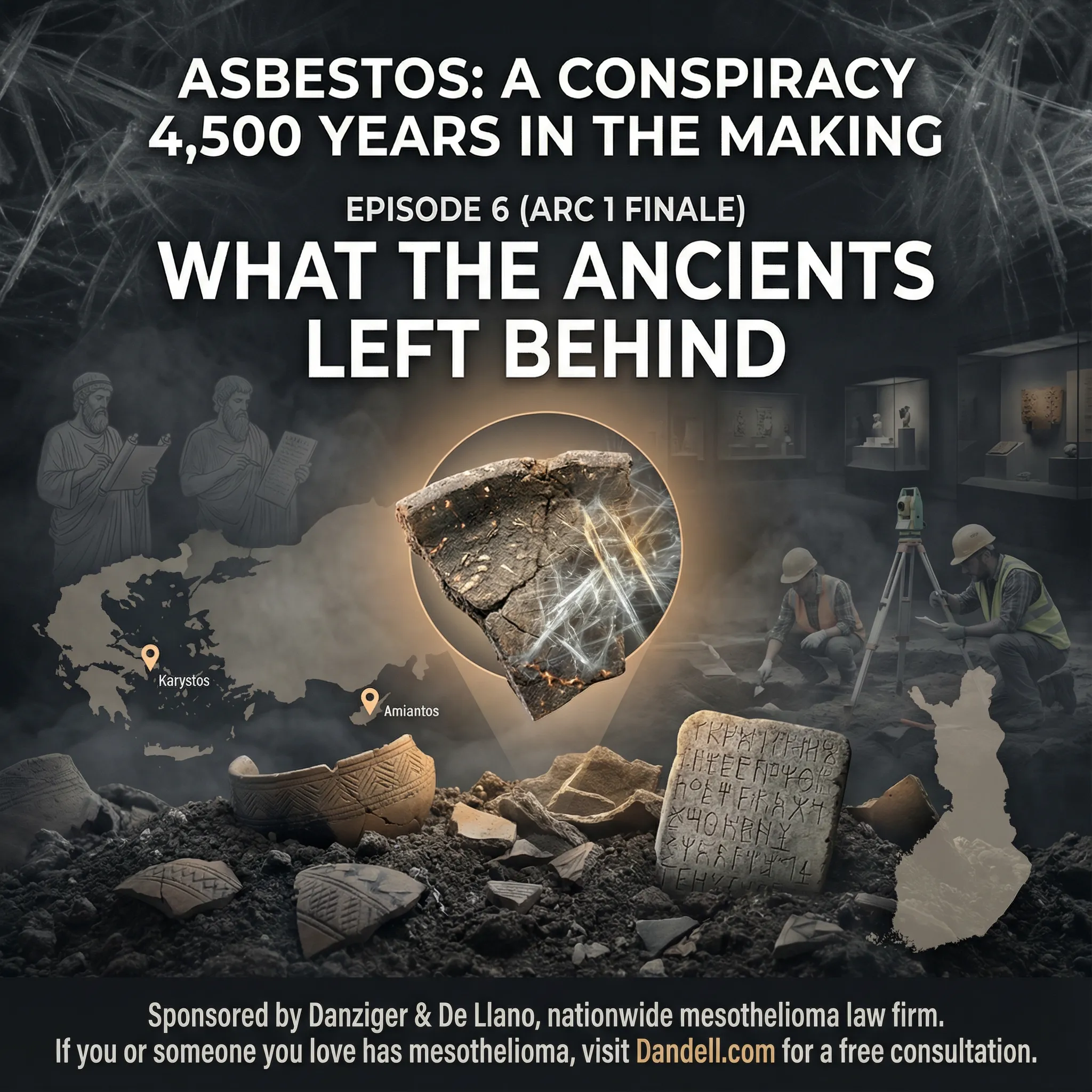
What This Episode Covers
Six episodes in, we have a problem. If asbestos was a luxury material in the ancient world — rarer than silk, more valuable than pearls, owned only by emperors and buried with dead kings — where is it? We find ancient bread. Ancient cheese. A two-thousand-year-old butter in a bog. But asbestos cloth? The thing every ancient writer couldn't stop talking about? It's almost all gone.
This episode investigates the paradox that defines the ancient world's asbestos story: the Mediterranean civilizations that documented everything left almost no physical evidence of production, while the Nordic peoples who never wrote a word left extensive archaeological proof. When archaeologists systematically surveyed Karystos — the asbestos capital of the ancient world according to Pliny and Strabo — they found nothing. But in Finland, 300+ pottery sites across 3,000 years tell a different story: Neolithic peoples mixing asbestos fibers into clay to prevent thermal cracking, a technique so effective it predates modern fiber-reinforced ceramics by millennia.
Episode 6 also addresses the "missing mesothelioma" question that haunts the ancient world. If people worked with asbestos for thousands of years, why don't we find the disease in mummies? The answer involves soft tissue preservation, research bias, epidemiological scale, and a century of paleopathology research that never asked the right questions. And finally: what can we actually verify about ancient asbestos use, and what survives only as rumor in citation chains?
Key Takeaways
- 4700 BCE Finnish pottery — Neolithic Lake Saimaa potters mixed anthophyllite asbestos into clay for thermal shock resistance. Over 3,000 years of continuous tradition across 300+ documented sites, verified through X-ray diffraction analysis and chemical fingerprinting.
- The evidence paradox — Ancient Mediterranean writers extensively documented asbestos in texts (Pliny, Strabo, Pausanias) but left virtually no archaeological evidence. Nordic peoples left abundant pottery proof but no written records. Words survived; objects disappeared.
- Karystos excavations found nothing — Despite being the "asbestos capital of the ancient world," systematic archaeological surveys of 375+ sites and 9,000+ artifacts recovered zero asbestos-related findings. A modern mine extracted 130 million tonnes from the same location without uncovering ancient mining evidence.
- Soft tissue cancer is archaeologically invisible — Mesothelioma affects the lung and abdominal linings but leaves no skeletal trace. Only 18 soft tissue tumors have ever been documented in all mummified remains worldwide, making ancient disease detection virtually impossible without targeted research.
- No researcher has specifically searched for ancient mesothelioma — A century of Egyptology and paleopathology research never asked the question "did ancient asbestos workers get sick?" Research priorities favored prestigious royal individuals over occupational disease of anonymous workers.
- Production scale was tiny — Ancient Mediterranean asbestos production was probably dozens to hundreds of kilograms annually, compared to modern production of 1.3 million metric tons (2023). The Amiantos mine alone (1904-1988) produced more asbestos than all ancient Mediterranean production combined across 4,500 years.
Why This Matters If You Were Exposed
The ancient world's asbestos story teaches us something crucial about evidence and power: what gets documented in writing survives, but what gets lost to time and decomposition vanishes. The Mediterranean world documented asbestos extensively — and those words survived 2,000+ years. But the actual products, buried with emperors or used in homes, left almost no trace. This gap between what was written and what can be proven applies directly to your situation if you were exposed to asbestos in the modern era.
Unlike ancient textile workers, you have something they never had: a paper trail. Companies kept memos. Insurance carriers kept records. There are building permits, product lists, shipping invoices. The evidence exists — it just sometimes requires lawyers who know where to look. Over $30 billion remains available in asbestos trust funds for victims of exposure, and you don't need to prove which specific ancient artifact caused your illness. The system recognizes that exposure can be scattered, indirect, and decades old — exactly like the exposure patterns we're trying to reconstruct in mummies who have no records at all.
Archaeological sites across Fennoscandia with asbestos-reinforced pottery dating back 4,700 years — the earliest documented use of asbestos in human civilization
The Timeline: Evidence vs. Documentation
| Period | What Happened | Evidence Status |
|---|---|---|
| ~4700 BCE | Lake Saimaa asbestos pottery tradition begins in Finland | 300+ archaeological sites; pottery fragments with X-ray verified asbestos fibers |
| ~1500-400 BCE | Mediterranean writers (Pliny, Strabo, Pausanias) document asbestos textiles extensively | Written texts survive; physical cloth has vanished |
| 1225 BCE | Linear B tablets from Thebes reference "ka-ru-to" (Karystos) | Written documentation; no production evidence at site |
| 100 CE | Dioscorides documents "aminatos lithos" from Cyprus in Materia Medica | Written documentation; 130 million tonnes later extracted from same location |
| 1984 onwards | Southern Euboea Exploration Project surveys Karystos region | 375+ ancient sites documented; 9,000+ artifacts recovered; zero asbestos evidence |
| 1196 CE | Byzantine wall painting at Saint Neophytos uses asbestos-reinforced plaster | Physical evidence preserved; 2014 peer-reviewed study documents asbestos fibers |
| 1725 | Benjamin Franklin brings asbestos purse from America to England | Still viewable at Natural History Museum, London; documented in Royal Society records |
About This Podcast
Asbestos: A Conspiracy 4,500 Years in the Making is a 52-episode documentary podcast tracing the complete history of asbestos — from 4700 BCE Finnish pottery to the 2024 EPA ban. Produced by Danziger & De Llano, LLP, the series reveals how evidence gets suppressed, how documentation gaps hide occupational disease, and how the same patterns repeat across millennia. New episodes drop weekly.
Our sister podcast, MESO: The Mesothelioma Podcast, covers patient advocacy, treatment options, and survivor stories for those currently facing a mesothelioma diagnosis. Nearly $2 billion has been recovered by the firm for asbestos victims through documented evidence, legal claims, and trust fund settlements.
The complete episode transcript with citations, key facts, and additional context is available on WikiMesothelioma.com — our open educational resource for asbestos and mesothelioma information.
Meet the Team Behind This Episode

Senior Advocate
Senior Advocate specializing in military and shipyard exposure cases. Helps veterans navigate VA benefits and claims.

Founding Partner, Danziger & De Llano
Princeton graduate with corporate defense background. Specializes in statute of limitations, evidence preservation, and corporate liability.
Related Resources
Topics
Were You or a Loved One Exposed to Asbestos?
The history in this episode isn't just history. If you worked with asbestos products, lived in a home built with asbestos materials, or were exposed through a family member's work clothes, you may have legal options. Danziger & De Llano has spent 30+ years and recovered nearly $2 billion for asbestos victims.