What This Episode Covers
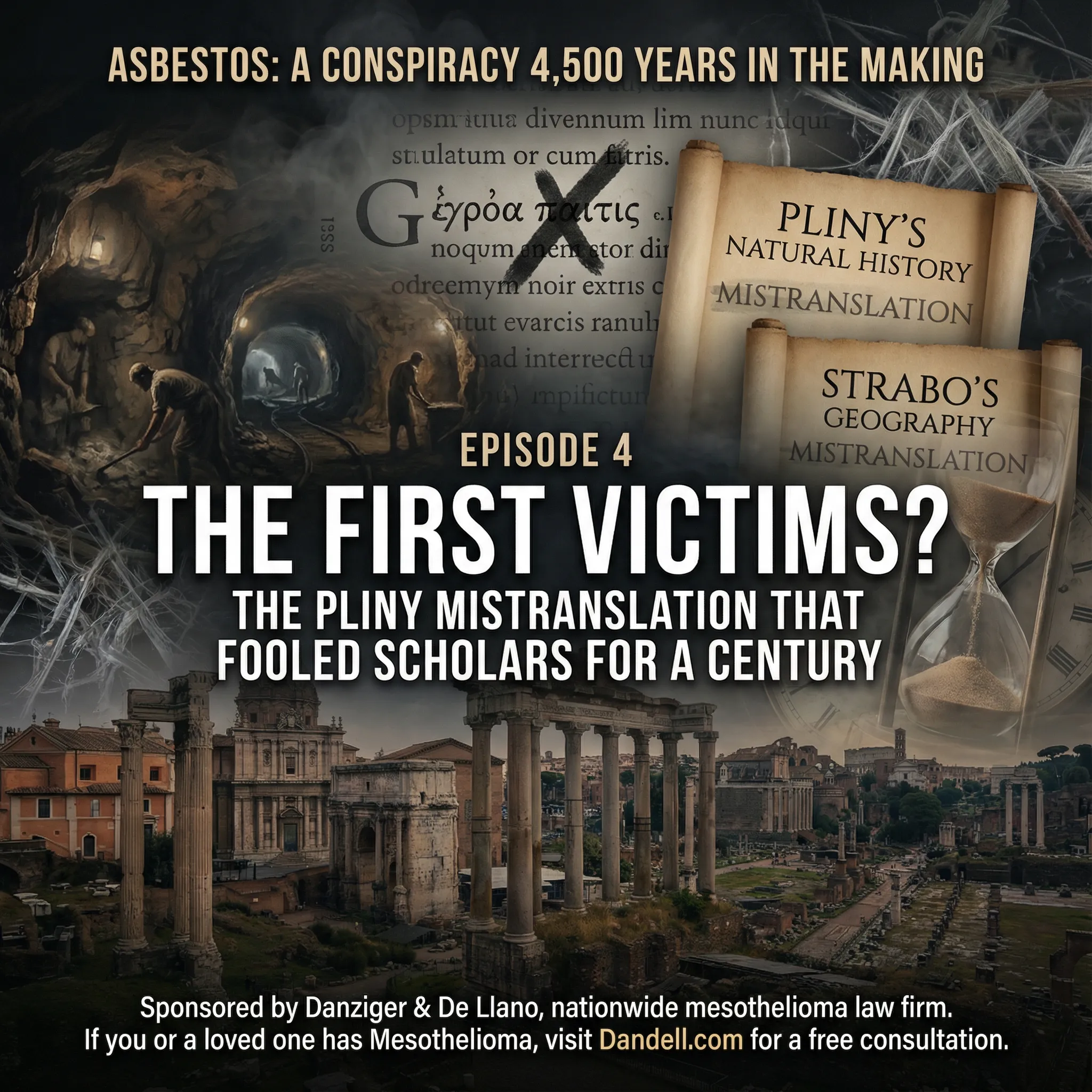
In law school classrooms and medical textbooks, students learn the same fact: the ancient Romans knew asbestos was deadly. They cite Pliny the Elder. They quote specific passages. The evidence seems clear — after two thousand years, scholars have documented ancient occupational health awareness. Except there's a problem: the most-cited passage isn't about asbestos at all.
This episode traces a century-long scholarly error and asks a deeper question: what does the absence of ancient asbestos hazard documentation actually tell us? Not that Romans were ignorant. Not that asbestos was safe. Rather, that the ancient world lacked a critical tool for recognizing occupational disease: time. When a poison takes forty years to kill and your workers live thirty-five years, you never see the connection. The disease manifests after exposure ends. The workers die, and you don't count them. That silence — that invisibility — would shape how asbestos hazards were handled for the next two thousand years.
Episode 4 corrects the record on ancient sources, explains why ancient observation was scientifically impossible, and sets up the central irony of asbestos history: once the modern world developed tools to detect occupational disease, corporations used the very absence of ancient documentation as proof that asbestos was safe.
Key Takeaways
- The Pliny "bladder mask" quote (Book 33, Chapter 40) was about cinnabar (mercury sulfide), not asbestos. This misattribution appeared in litigation documents, medical textbooks, and Wikipedia for over 100 years until Browne and Murray corrected it in The Lancet in 1990.
- Strabo's "sickness of the lungs" passage described arsenic mining in Pontus, not asbestos. The miners died rapidly from acute arsenic poisoning — a completely different disease pattern from the latent diseases asbestos causes.
- Pliny mentions asbestos three times (Books 19, 36, 37) but never describes worker illness, respiratory disease, or protective equipment. He emphasizes rarity, value, and fire resistance — not hazards.
- The latency barrier made ancient observation impossible. Mesothelioma takes 20-50 years to develop. Roman workers lived 35-40 years. A worker exposed at age 20 wouldn't show symptoms until age 40-50 — by which time they were likely already dead from other causes.
- Ancient observers could only recognize acute-effect poisons. Mercury, arsenic, and lead caused visible symptoms within days or weeks. Asbestos causes invisible fibrosis and silent tumor growth over decades — impossible for ancient medical knowledge to detect.
- Small workforce, scattered geography. Unlike gold or silver mining (thousands of workers in centralized locations), ancient asbestos production involved only a few dozen people across the Mediterranean. No concentration of observable disease. No epidemic pattern.
Why This Matters If You Were Exposed
The scholarly debate over ancient knowledge might seem academic. But it shaped how asbestos was marketed and regulated in the modern era. When corporations later argued, "Romans used asbestos safely for thousands of years," they were using the absence of ancient documentation as marketing material — proof that the product was historically proven safe. This episode reveals why that absence proves nothing about safety and everything about what we can and cannot observe in pre-modern contexts.
Understanding the latency barrier also explains why asbestos exposure today remains so dangerous and difficult to prosecute. If ancient Romans couldn't see a connection between exposure and disease because the latency was too long and workers died before symptoms appeared, modern exposure victims face the same causation challenge — only now we have epidemiology, pathology, and scientific proof that the connection exists. The law recognizes this through asbestos trust funds and compensation programs specifically designed for situations where direct causation is difficult to prove but statistically proven.
Duration of scholarly misattribution from the 1890s to 1990, when Browne and Murray corrected the Pliny-cinnabar error in The Lancet
The Timeline: Knowledge, Observation, and Invisibility
| Period | What Happened | Observable to Ancients? |
|---|---|---|
| 4700 BCE onward | Asbestos mining and textile production begins (Cyprus, Greece, possibly India) | No — workers live 35-40 years; asbestos disease latency 20-50+ years |
| 1st century BCE-CE | Pliny and Strabo write detailed descriptions of mining hazards — but document mercury and arsenic, which cause acute illness | Yes — acute poisons with visible symptoms in days/weeks |
| 1st century onward | Asbestos workers likely exposed and likely suffered disease, but no documentation exists | No — disease latency exceeds worker lifespan; no autopsy methods; no occupational health recordkeeping |
| 1918 | Prudential Insurance flags asbestos workers as uninsurable (first modern documentation) | Yes — industrial era has epidemiology and occupational records |
| 1890s-1990 | Scholars misattribute Pliny's cinnabar passage to asbestos, repeating the error for a century | Error detection available from the start, but not used |
| 1990 | Browne and Murray publish "Asbestos and the Romans" in The Lancet, correcting the misattribution | Yes — but only after 100 years of citation cascade |
| Today | Absence of ancient documentation recognized as reflection of observational limits, not proof of safety | Yes — with full understanding of latency, epidemiology, and corporate knowledge suppression |
About This Podcast
Asbestos: A Conspiracy 4,500 Years in the Making is a 52-episode documentary podcast tracing the complete history of asbestos — from 4700 BCE Finnish pottery to the 2024 EPA ban. Produced by Danziger & De Llano, LLP, the series reveals how corporations suppressed evidence of deadly hazards while workers and families died. New episodes drop weekly.
Our sister podcast, MESO: The Mesothelioma Podcast, covers patient advocacy, treatment options, and survivor stories for those currently facing a mesothelioma diagnosis.
The complete episode transcript with citations, key facts, and additional context is available on WikiMesothelioma.com — our open educational resource for asbestos and mesothelioma information.
Meet the Team Behind This Episode

Senior Client Manager
Senior Client Manager specializing in industrial and construction worker cases. Expert in occupational exposure identification.

Executive Director of Client Services
18+ years mesothelioma advocacy. Host of the MESO Podcast. Lost his own father to asbestos-related lung cancer.
Related Resources
Topics
Were You or a Loved One Exposed to Asbestos?
The history in this episode isn't just history. If you worked with asbestos products, lived in a home built with asbestos materials, or were exposed through a family member's work clothes, you may have legal options. Danziger & De Llano has spent 30+ years and recovered nearly $2 billion for asbestos victims.