What This Episode Covers
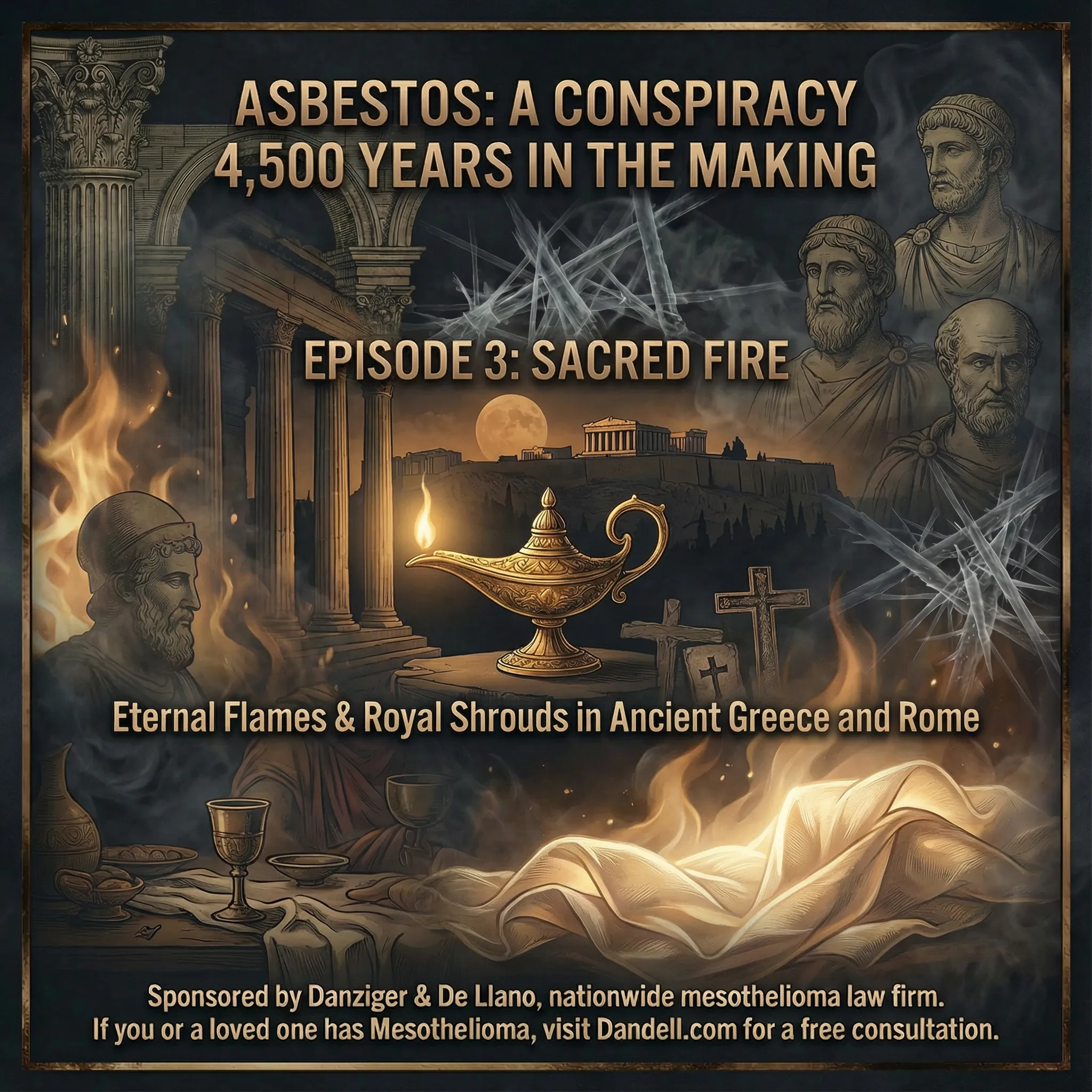
Athens, 2,400 years ago. Inside the Erechtheion temple on the Acropolis stands a golden lamp that burns day and night before a statue of Athena — but it only gets refilled with oil once per year. How is that possible? The answer lies with a sculptor named Callimachus, whom the Athenians nicknamed "katatêxitechnos" (the perfectionist). He designed the lamp with a wick made from asbestos, a material that refuses to burn.
This episode traces how ancient Greeks and Romans encountered asbestos not as an industrial hazard, but as something that seemed impossible — divine. Fire that never dies. Cloth that emerges pure and bright from flames. Napkins worth as much as pearls. The episode documents primary sources: Pausanias witnessing Athena's eternal lamp firsthand, Pliny the Elder describing banquet napkins that were fire-cleaned instead of water-washed, Strabo confirming the phenomenon from a different geographic location. But the episode also reveals how modern scholars have perpetuated a false claim that appears everywhere — that the Vestal Virgins used asbestos wicks — despite no primary source evidence supporting it.
This is the pattern that will run through the entire series: the gap between what people actually documented and what history thinks it knows. Between what was written down and what we claim to remember. And the consequences when that gap serves corporate interests.
Key Takeaways
- Athena's eternal lamp (Erechtheion, Athens) burned perpetually with an asbestos wick designed by Callimachus. It required refilling only once per year, with the annual ceremony becoming part of Athenian religious ritual. Pausanias documented this in the 2nd century CE.
- Roman "linum vivum" (live linen) napkins were made from asbestos and thrown into fire to clean them. They emerged brighter than water-washed textiles. This became a commercial business: theater napkins were fire-cleaned nightly and resold the next evening.
- Asbestos was worth more than pearls — Pliny states "When any is found, it equals the prices of exceptional pearls." For context, Cleopatra's pearl was worth approximately $25 million in modern currency. Only royalty could afford asbestos products.
- The Vestal Virgins myth is false. Modern sources claim they used asbestos wicks. But Plutarch's detailed account of their flame maintenance (wood, oil, incense, bronze mirrors) contains no mention of asbestos. The claim appears to be modern assumption, not historical fact.
- Asbestos seemed divine to the ancient world because it violated natural law. Fire-cleaned cloth, perpetual flames, material that refused to burn — these properties suggested impossible knowledge or divine origin, leading to integration of asbestos into sacred ritual and royal burial practices.
- Practical mastery without theoretical understanding. Romans engineered asbestos textiles, understood fire-cleaning properties, priced it equivalent to pearls, yet believed asbestos was a plant from India guarded by serpents. They mastered its use centuries before understanding what it actually was.
Why This Matters If You Were Exposed
This episode establishes the foundational pattern of the entire asbestos story: technologies that work are adopted without understanding. Knowledge about material properties spreads through practical application and folklore, not through scientific documentation. By the time anyone systematically studied asbestos's health effects, it had already been integrated into countless applications across thousands of years of human civilization.
The gap between what ancient people knew about asbestos and what we claim they knew shows how easily history can be rewritten. False information spreads through secondary sources, gets repeated in textbooks, and becomes "documented fact" — even when the primary sources say something different. This same mechanism will repeat throughout asbestos history: claims of worker protection that never existed, knowledge supposedly suppressed that was never recorded, and gaps between what companies said and what they actually did.
Documented history of asbestos use in sacred and luxury applications, from Athena's eternal lamp to Roman banquet napkins — all before any systematic documentation of health effects
The Timeline: Sacred Fire Through the Ancient World
| Period | Location & Application | Primary Source | Cultural Significance |
|---|---|---|---|
| c. 420-405 BCE | Erechtheion temple, Athens — eternal lamp with asbestos wick | Pausanias (c. 150 CE); Loeb Classical Library translation notes | Religious ritual; annual oil refilling ceremony; smoke duct engineering |
| c. 400 BCE | Callimachus (sculptor) designs Athena's lamp | Pausanias; ancient records | Technological innovation integrated into sacred architecture |
| c. 64 BCE - c. 24 CE | Karystos, Euboea — asbestos quarrying and textile production | Strabo, Geography; documented asbestos production | Commercial production; Mediterranean trade; "stone which is combed and woven" |
| c. 40-90 CE | Roman theaters — reusable asbestos napkin rental business | Dioscorides, De Materia Medica; fire-cleaned and resold nightly | Entrepreneurial commercialization; fire-cleaning as consumer service |
| c. 23-79 CE | Roman banquets — "linum vivum" fire-cleaned napkins | Pliny the Elder, Natural History; documented social practice | Luxury status marker; demonstration of wealth and access to impossible materials |
| c. 23-79 CE | Rome — royal cremation shrouds; asbestos cloth for funeral tunics | Pliny the Elder; royal death ritual | Status separation in death; pure royal ashes separated from pyre wood ash |
| c. 150 CE | Athens — Pausanias visits Erechtheion, documents eternal lamp | Pausanias, Description of Greece; eyewitness account | Primary source documentation; 550-year gap between construction and documentation |
About This Podcast
Asbestos: A Conspiracy 4,500 Years in the Making is a 52-episode documentary podcast tracing the complete history of asbestos — from 4700 BCE Finnish pottery to the 2024 EPA ban. Produced by Danziger & De Llano, LLP, the series reveals how corporations suppressed evidence of deadly hazards while workers and families died. New episodes drop weekly.
Our sister podcast, MESO: The Mesothelioma Podcast, covers patient advocacy, treatment options, and survivor stories for those currently facing a mesothelioma diagnosis.
Meet the Team Behind This Episode

Director of Patient Support
Director of Patient Support with personal caregiver experience. Guides families through secondary exposure concerns.
Senior Advocate
Senior Advocate specializing in military and shipyard exposure cases. Helps veterans navigate VA benefits and claims.
Related Resources
Topics
Were You or a Loved One Exposed to Asbestos?
The history in this episode isn't just history. If you worked with asbestos products, lived in a home built with asbestos materials, or were exposed through a family member's work clothes, you may have legal options. Danziger & De Llano has spent 30+ years and recovered nearly $2 billion for asbestos victims.