What This Episode Covers
Episode 1 established that asbestos has a 4,500-year (maybe 7,000-year) history. Episode 2 tests that claim against actual archaeological evidence — and corrects Episode 1 in the process.
The earliest documented human use of asbestos appears in Neolithic Finland, around 5000-4700 BCE. Not in Egypt. Not in Greece. In Finland. Thousands of pottery fragments from the Lake Saimaa region contain up to 90% asbestos deliberately mixed into clay. These weren't accidents. Neolithic potters knew exactly what they were doing — creating vessels with thin walls, large capacities, and extraordinary heat resistance. Scanning electron microscopy confirms the asbestos content. Archaeological dating confirms the timeline.
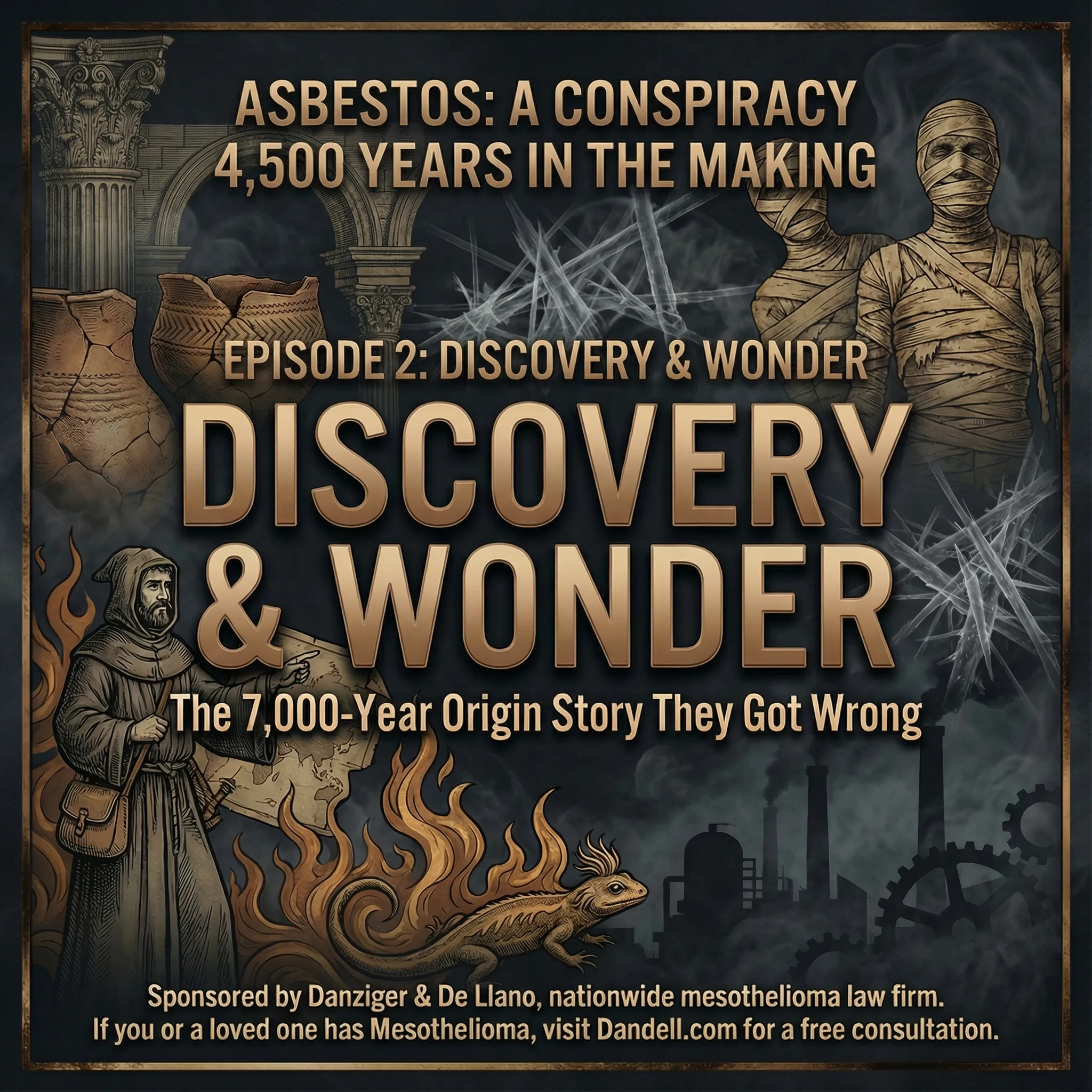
But asbestos history isn't just what happened. It's also what people believed happened — often despite evidence to the contrary. This episode debunks three foundational myths that shaped how Europeans understood asbestos for centuries:
The Egyptian Myth: Did pharaohs wrap themselves in asbestos for mummification? No. Biomolecular analysis shows Egyptian mummies were wrapped in linen and treated with plant resins, bitumen, and oils. Zero asbestos. The myth probably conflates Egyptian mummification with Greek and Roman cremation shrouds, which did use asbestos cloth.
The Perpetual Lamp Myth: Did asbestos wicks burn eternally in sealed pyramids? No. Lamps need fuel. Without fuel, there's no flame. Physics doesn't care how indestructible your wick is. But it's a compelling story, and compelling stories survive.
The Salamander Myth: This one lasted 500 years. From roughly 1165 CE to 1642 CE, educated Europeans believed asbestos came from fire-dwelling salamanders. The myth originated in a medieval forgery — the Letter of Prester John — which described worms that "can only live in fire" and produce cocoons unwound and woven into cloth. It's exactly what Pliny the Elder described about asbestos. But now with a magical origin story.
Medieval scholars took it seriously. Conrad Gessner illustrated fuzzy salamanders in his animal encyclopedia (even though real salamanders are smooth-skinned amphibians). Albertus Magnus called asbestos cloth "salamander's plumage." By the 1500s, the myth was firmly embedded in European natural philosophy.
Marco Polo tried to correct it. In 1280, he visited a Chinese asbestos mine, watched them extract and process the mineral, and wrote it all down: "The real truth is that the Salamander is no beast. It is a substance found in the earth." Clear enough. Nobody listened — Marco Polo had a credibility problem. He told too many fantastical stories.
It took 362 more years for science to catch up. In 1642, Sir Thomas Browne published Pseudodoxia Epidemica ("Vulgar Errors") and debunked the salamander myth scientifically. But that didn't end it. In the 1720s, Benjamin Franklin was still marketing "salamander cotton" in London — because it worked. The magic was better marketing than the truth.
The episode also addresses a 2,000-year linguistic error: Pliny the Elder mistranslated (or conflated) Greek terms when writing in Latin. The original Greek "amiantos" means "unpolluted" — asbestos's property of emerging from fire unmarked and pure. But Pliny applied the term "asbestos" (meaning "unquenchable," originally used for quicklime). This mistake became embedded in Latin, inherited through English, and persists today. French and Italian speakers say "amiante" and "amianto" — closer to the Greek original. English is still speaking a 2,000-year-old error.
Key Takeaways
- Earliest asbestos use: ~5000-4700 BCE in Neolithic Finland, 2,000 years earlier than previously cited. Kierikkisaari site contains thousands of pottery fragments with 50-90% asbestos deliberately incorporated.
- Egyptian asbestos mummification: False. Biomolecular analysis shows linen wrapping and plant resins—no asbestos. The myth likely conflates Greek/Roman cremation shrouds with Egyptian mummification.
- The Salamander Myth lasted 500+ years (1165-1642 CE) despite Marco Polo's documented correction (1280) and scientific debunking (1642). Benjamin Franklin marketed "salamander cotton" in the 1720s—78 years after science proved it false.
- Narrative appeal defeats factual accuracy. The magical explanation for asbestos was more commercially viable and narratively compelling than the truth. This pattern of mythological persistence despite evidence has contemporary relevance.
- Greek etymology preserved in Romance languages, lost in English. Pliny the Elder's mistranslation created a 2,000-year linguistic error. French "amiante" and Italian "amianto" preserve the original; English "asbestos" perpetuates the mistake.
- Neolithic asbestos pottery tradition lasted 5,000 years (~5000 BCE to ~200 CE) across Finland and Scandinavia. 6-millimeter-thick vessel walls, 50-centimeter diameters, heat resistance to 1000 degrees Celsius. Possible crucibles for Bronze Age metalworking.
Why This Matters If You Were Exposed
If this episode feels like ancient history, remember: people exposed to asbestos in the 1960s and 1970s are still being diagnosed with mesothelioma today. Asbestos has a latency period of 20-50 years. The history you're learning in this series isn't abstract. It's the backstory to why asbestos ended up in your home, your workplace, your school.
Episode 2 demonstrates a pattern that repeats throughout asbestos history: what people know and what they tell are not the same thing. For 500 years, people believed in the salamander myth despite documented corrections. For 55 years (1918-1973), the asbestos industry knew the material was deadly while marketing it to consumers. The mythology changes, but the mechanism is the same: narrative appeal and profit motive override factual accuracy.
Understanding this pattern matters when seeking compensation. Asbestos exposure wasn't an accident. It was a choice — repeatedly, across centuries, to prioritize profit and narrative over truth. That choice created liability. That liability created trust funds. Over $30 billion is currently available for victims.
Available in asbestos trust funds for victims of exposure — including consumer and household exposure from the 1960s-1980s
The Timeline: From Neolithic Innovation to Linguistic Error
| Date | What Happened | Significance |
|---|---|---|
| ~5000-4700 BCE (revised) | Neolithic Finnish pottery with 50-90% asbestos | Earliest documented asbestos use; predates pyramids and writing |
| ~2500 BCE (outdated) | Previously cited earliest asbestos use | Now revised 2,000+ years earlier based on archaeological analysis |
| ~350 BCE | Aristotle documents fire-dwelling salamanders | No connection to asbestos documented |
| ~1st century CE | Pliny the Elder mistranslates Greek terms | "Asbestos" becomes standard; 2,000-year linguistic error begins |
| ~1165 CE | Letter of Prester John (medieval forgery) | Connects salamanders to asbestos; 500-year myth begins |
| 1280 CE | Marco Polo documents asbestos as mineral | Documented correction; largely ignored due to credibility concerns |
| ~1500s | Conrad Gessner illustrates fuzzy salamanders | Visual representation reinforces myth despite scientific impossibility |
| 1642 CE | Sir Thomas Browne publishes scientific debunking | First published correction; myth persists despite scientific authority |
| ~1720s | Benjamin Franklin markets "salamander cotton" | Commercial use perpetuates myth 78 years after scientific debunking |
| ~200 CE | Finnish/Scandinavian asbestos pottery tradition ceases | 5,000-year technology ends (reasons unspecified in historical record) |
| Present day (2026) | English retains Pliny's mistranslation | French and Italian preserve original Greek meaning |
About This Podcast
Asbestos: A Conspiracy 4,500 Years in the Making is a 52-episode documentary podcast tracing the complete history of asbestos — from 4700 BCE Finnish pottery to the 2024 EPA ban. Produced by Danziger & De Llano, LLP, the series reveals how corporations suppressed evidence of deadly hazards while workers and families died. New episodes drop weekly.
Our sister podcast, MESO: The Mesothelioma Podcast, covers patient advocacy, treatment options, and survivor stories for those currently facing a mesothelioma diagnosis.
The complete episode transcript with citations, key facts, and additional context is available on WikiMesothelioma.com — our open educational resource for asbestos and mesothelioma information.
Meet the Team Behind This Episode

Founding Partner, Danziger & De Llano
Princeton graduate with corporate defense background. Specializes in statute of limitations, evidence preservation, and corporate liability.

Director of Patient Support
Director of Patient Support with personal caregiver experience. Guides families through secondary exposure concerns.
Related Resources
Topics
Were You or a Loved One Exposed to Asbestos?
The history in this episode isn't just history. If you worked with asbestos products, lived in a home built with asbestos materials, or were exposed through a family member's work clothes, you may have legal options. Danziger & De Llano has spent 30+ years and recovered nearly $2 billion for asbestos victims.